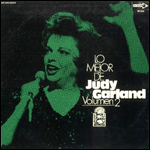
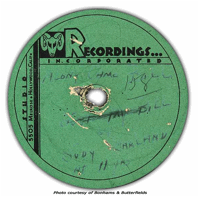
 Judy Garland’s association with Decca Records began on March 29, 1935. On that date, the 12-year-old Vaudevillian and her two sisters, as “The Garland Sisters,” made a demo (test) recording of “Moonglow.” Judy, going by “Francis Garland” at the time, soloed on “Bill” and a medley of “On The Good Ship Lollipop/The Object of My Affection/Dinah.” Those latter two are the only recordings from this session to have survived. They are also the very first studio recordings ever made of Judy Garland singing.
The tests were rejected, but not before Judy’s “Bill”” solo was sent to Decca’s president Jack Kapp in New York by the label’s Los Angeles executive Joe Perry. Perry was enthusiastic about Judy after recently seeing the sisters perform between showings of a film at a local movie theater. On the surviving log, he wrote a note to Kapp, “12 yr. Old Girl I Wrote About, 3/29/35 – Joe.”* Kapp was either not impressed or maybe he didn’t hear the record at all, because at that point Judy did not receive a contract.
On 11/27/1935, Judy went back to the Decca Recording Studios, now as "Judy Garland,” and recorded two more test recordings: "All's Well (Down In Coronado By The Sea)" and "No Other One" with Victor Young conducting (he would conduct her first commercial recording of "Over The Rainbow" on July 28, 1939). By this second test session, at age 13, Judy had already had several milestone events in her life and career:
- She auditioned for and was signed by MGM Studios on September 13, 1935 (the contract was drawn up on September 16, 1935).
- She made her first "official" nationwide radio appearance (via MGM) on October 26, 1935. She sang "Broadway Rhythm" on NBC Radio's Shell Chateau Hour hosted by Wallace Beery. Judy had already been a part of various local and regional radio programs for years, and she was well known especially in the Los Angeles area. This is the earliest known recording of a Judy Garland radio performance.
- Her father passed away on November 17, 1935. In her words "the most terrible thing that ever happened to me in my life.”
In late November 1935, Decca president Jack Kapp was in Los Angeles signing new talent to the then still young label. As reported by Variety a week later, Kapp signed several artists before returning to New York, and Judy was listed a part of that new talent. Variety described Judy as “the 12-year-old Metro contractee-songstress.” The details of that first contract or agreement are unknown as no documents have survived.
The newly discovered information about this 1935 contract changed the previous “official Decca Records timeline” which maintained that Judy signed her first contract with the label in August 1937. According to Decca, Kapp saw a screening of Broadway Melody of 1938 at the Village Theater in West Los Angeles in late August 1937. He was so impressed with Judy’s performance that he drew up a contract that same night. That contract was for six months. On August 30, 1937, Judy signed the contract (being a minor the contract was co-signed by her mother, Ethel) and also recorded her first singles under that new contract, “Everybody Sing” and “All God’s Chillun Got Rhythm.”
To confuse things, a year prior on June 12, 1936, Judy recorded “Swing, Mr. Charlie” and “Stompin’ At The Savoy” at the label’s New York studios. She was in the city for an MGM promotional tour. The two songs were released as a single in July 1936. These are considered to be Judy’s first “official” recordings made for Decca but according to the label session and single release did not result in a contract. It has always seemed odd that Decca would have Judy record two songs, release them, and still not put her under contract. It’s also odd that considering his apparent previous enthusiasm (1935) for Judy and then his later enthusiasm (1937) Kapp wasn’t enthusiastic about her in the interim when she was in New York recording at their studios (1936). Maybe he was out of town.
What might explain this anomaly is that her contract from November 1935 was “per-side” (per-song) but for whatever reason, she didn’t record anything until June 1936. If Decca had created a six-month contract with Judy in late November 1935, that contract would have expired before those June recordings were made, unless she had been signed per-side of which that 1936 single might have been the fulfillment of that contract.
It’s also possible that from late November 1935 through August 1937, Judy was actually still associated with the label either through a succession of now-lost contracts for a number of per-side recordings or now-lost time-constrained contract(s). Considering what else has been lost, especially from those early years (Decca was still a young company), this is a very likely scenario.
After the signing of that 1937 contract, Judy stayed with the label for a full decade, recording her last singes on November 15, 1947. All of her contracts with the label from 1935 through 1947, excepting two, were for finite numbers of “per side” (per song) recordings.
Judy had several hit records out of the 90 recordings she made for the label. Her biggest hit was not “Over The Rainbow” as most people would suggest but rather it was "I'm Nobody’s Baby” which peaked at the #3 spot in 1940 and “The Trolley Song” which also peaked at the #3 spot, in 1944. Her other hit singles were, “Over The Rainbow” (peaked at #5), “For Me And My Gal” (with Gene Kelly) (peaked at #5), ”Yah-Ta-Ta, Yah-Ta-Ta (Talk, Talk, Talk)" (duet with Bing Crosby) (peaked at #5), “On The Atchison, Topeka & the Santa Fe" (with The Merry Macs) (peaked at #10).
Judy was also a part of no less four “Cast Albums” of songs from her movies, a concept the Decca pioneered. It must be noted that none of these were soundtrack albums and were not “cast albums” as we’ve come to know them which are albums of the casts/scores of Broadway shows. They words are “cast” (Broadway) and “soundtrack” (film). 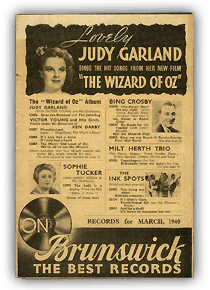
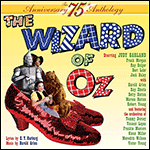
In 1940, Decca released an album of “the music score from” The Wizard of Oz. Judy is only featured on two recordings in the set, “Over The Rainbow” and “The Jitterbug” which are both studio recordings and not from the film’s soundtrack, released together as a single in September 1939. The rest of the songs in the set were studio recordings featuring The Ken Darby singers performing very different arrangements of songs heard in the film. Three more movie-released albums were produced in 1944 and 1945, Girl Crazy, Meet Me In St. Louis, and The Harvey Girls. The latter went to great lengths to recreate in the Decca studios the arrangements and sound of the songs as they are heard in the film.
Judy’s last recording session for Decca as on November 15, 1947. Earlier in the year MGM Records (which had been created in 1946) released its first album which was selections from the soundtrack of Till The Clouds Roll By. That album featured Judy’s two songs from the film and it was the first in a new market of movie soundtrack albums featuring selections directly from the soundtracks of those films (with some judicial edits for time constraints). It would have been redundant for Judy to then go into the Decca studios and record separate covers of songs from her films. MGM wouldn’t have wanted that competition anyway. Decca still retained the right to call on Judy for her services, but that came to an end when her contract ended in 1950 around the same time as her departure from MGM.
It wasn’t until 1953, riding the crest of her historic return to the stage (and the beginning of her legendary "Concert Years"), when Judy signed another contract with a label. She signed with Columbia Records which resulted in four singles (“Without A Memory,” “Heartbroken,” “Go Home Joe,” “Send My Baby Back To Me”) and the soundtrack album for 1954’s A Star Is Born.
In 1955, Judy signed with Capitol Records and produced some of the greatest studio albums ever recorded, including her first released in stereo. Judy's association with Capitol lasted from 1955 until 1966. The comparison of her Capitol catalog to her Decca catalog is like comparing night and day and yet, there is the commonality of Garland’s ever-changing and ever-maturing voice. Compare her Decca version of “You’ll Never Walk Alone” with her later Capitol version. They’re “the same only different” with the same arrangement and the same singer but different results - each dazzling in its own way.
The legacy of Judy Garland’s Decca recordings is unique. She began recording singles at a very young age, younger than anyone else at the time. The result is that when listening to those recordings in chronological order we get the unique experience of hearing her voice change and mature over time. We also get the chance to hear a genius talent gain confidence as she experiment with different styles of music. In addition to covers of songs from her MGM musicals, Judy also recorded songs as varied as “Stompin’ the the Savoy,” “Blues in the Night,” “The Star of the East,” and “There Is No Breeze.”
TECH INFO: The notes in the booklet for the Decca/MCA CD box set "Judy Garland - The Complete Decca Masters (Plus)" explain in wonderful detail the technical information about the recordings:
Garland's earliest recordings were cut using a huge mechanical lathe about the size of a small truck. The 78 rpm turntable was powered by the force of gravity; a flywheel underneath the machine was triggered by the release of a 250 lb. counterweight, which had to be hand-cranked back into position after each take.
Two three-inch thick wax "pies" were cut simultaneously on twin turntables. The first was used for playback reference during the session. The second was either held, if a take was chosen, or shaved clean, if the take was rejected. The master take would be designated "A," the second and third choices "B" or "C". The choice takes were then shipped to one of Decca's manufacturing plants where a hard copper/nickel replica "negative" was made. From this metal master another metal part called a mother, a playable positive copy of the master, was produced and eventually stampers and commercial shellac pressings.
During the 1942-43 recording ban, Decca purchased the World Broadcasting Company, a radio transcription service which recorded on 33 rpm acetate lacquers. World began transcribing Decca's recording sessions onto these 16" lacquer safeties, called "covers," which replaced the 78 rpm reference disc. While being good for multiple playbacks, those World transcriptions were also of superior fidelity and often preserved numerous takes other than the master.
* Note: Some of the information included here provided by the excellent booklet written by Ron O’Brien for the 1994 CD boxed set “Judy Garland The Complete Decca Masters (plus).”