|

 On
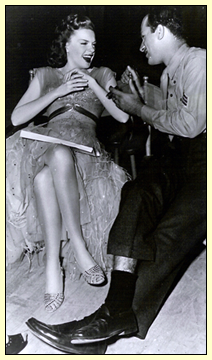
June 15, 1945 Judy Garland married Vincente Minnelli. It was her
second marriage, his first. It seemed like a match made in
MGM Heaven. Vincente had just risen to fame as the studio's premiere
musical director. He was the man responsible for completing Judy's seamless
transition from juvenile parts to adult roles, making her (with the
invaluable help of make-up maven Dottie Ponedel), into MGM's premier
leading lady of their musicals. Three of Judy's four films prior to Clouds had been directed by Vincente: Meet Me In St. Louis
- 1944 (in which Judy was made up for the first time by Dottie);
Ziegfeld Follies - 1946 (Judy's number filmed by Vincente
in 1944); and The Clock - 1945 (Judy's rare non-singing dramatic role). On
June 15, 1945 Judy Garland married Vincente Minnelli. It was her
second marriage, his first. It seemed like a match made in
MGM Heaven. Vincente had just risen to fame as the studio's premiere
musical director. He was the man responsible for completing Judy's seamless
transition from juvenile parts to adult roles, making her (with the
invaluable help of make-up maven Dottie Ponedel), into MGM's premier
leading lady of their musicals. Three of Judy's four films prior to Clouds had been directed by Vincente: Meet Me In St. Louis
- 1944 (in which Judy was made up for the first time by Dottie);
Ziegfeld Follies - 1946 (Judy's number filmed by Vincente
in 1944); and The Clock - 1945 (Judy's rare non-singing dramatic role).
Upon their return from a 10 week honeymoon, the couple announced that
Judy was pregnant. The studio wasted no time in re-scheduling her
scenes for Till The Clouds Roll By. Although the film
was directed by Richard Whorf, Judy's numbers were the creation
of her husband. When watching the film, Judy's scenes do have
a different look to them, especially the musical numbers.
Playing the part of Broadway legend Marilyn Miller, Judy was slated
to perform three numbers: "D'Ya Love Me?", "Sunny"/"Who?",
and "Look For The Silver Lining". The latter two had
been huge hits for Miller, but due to Vincente's direction and
of course, her own special magic, Judy made them into her own.
The first number, "D'Ya Love Me?" would be deleted from
the film prior to its release. And with good reason. The surviving
footage of the number (available only on the MGM/UA Laser Disc
"The Composers Collection") shows a number that is very
static and slow. 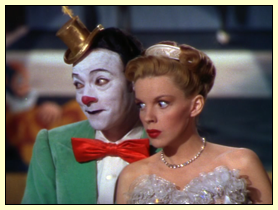 It was to take place during the circus number
("Sunny") but it obviously impeded the flow of the number
before it leads into "Who?". Even Vincente Minnelli
made a few misjudgments. The footage show's Judy mugging right
after the number is completed, showing that maybe she realized
the number was a misfire. It was to take place during the circus number
("Sunny") but it obviously impeded the flow of the number
before it leads into "Who?". Even Vincente Minnelli
made a few misjudgments. The footage show's Judy mugging right
after the number is completed, showing that maybe she realized
the number was a misfire.
The rest of Judy's sequences are excellent, and she is glowing
throughout. With good reason. While filming "Who?" she
was close to losing it, finding it hysterically funny to be running
around singing "Who stole my heart away?" to a group
of men while in her "condition" as an expecting mother.
During their honeymoon in New York, Judy and Vincente were walking
along the Hudson and Judy took out a bottle of pills and threw
them in, vowing to never take them again. She would stay off the
pills until after her pregnancy. The future was bright, and Judy
was looking forward to a new baby and domestic bliss. Judy completed
her work on the film on November 7, 1945.
Till
The Clouds Roll By was a first for producer Arthur Freed.
It was the first time the studio would make a musical "biography"
based on the life of a composer/songwriter. Arthur Freed would
have his hopes of having the first musical of this kind dashed
when, in 1945 during the production of Clouds, Warner
Bros. would release their version of George Gershwin's life entitled Rhapsody in Blue. But
Freed's production of Clouds would prove to be the more
popular of the two. Very loosely based on the life of Jerome Kern Clouds was really an excuse to show off the abundance of musical
talent at the studio, as well as their technical "know how"
and slick production values. Kern himself was a participant, but
died early in the filming, necessitating the script to be fictionalized
even more. The end result doesn't really portray Kern's life accurately,
but that didn't really matter. Kern's life was pretty void of
any "tabloid scandal" or real heart wrenching drama.
Instead, he was lucky to be able to concentrate on being one of
the pioneers of the American Musical. 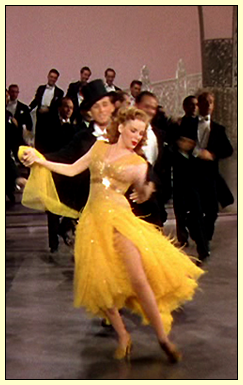 It's Kern's melodies, married
to Oscar Hammerstein's words, that make the seminal musical Show
Boat so powerful. As Till The Clouds Roll By shows, Kern was able to write serious, thought provoking music as well
as fun and light ditties. In fact, Kern's music is so beautiful,
and so beautifully arranged and orchestrated by Conrad Salinger,
that the studio decided to release several of the songs as pre-recorded
for the film on the first MGM Records soundtrack album. It's Kern's melodies, married
to Oscar Hammerstein's words, that make the seminal musical Show
Boat so powerful. As Till The Clouds Roll By shows, Kern was able to write serious, thought provoking music as well
as fun and light ditties. In fact, Kern's music is so beautiful,
and so beautifully arranged and orchestrated by Conrad Salinger,
that the studio decided to release several of the songs as pre-recorded
for the film on the first MGM Records soundtrack album.
In 1947, MGM Records created the
first "movie soundtrack album" when it
released the soundtrack of Till The Clouds Roll
By. Disney had released a few songs from Snow
White And The Seven Dwarfs on a limited RCA two record set,
however MGM's release of Clouds on record became the first
ever "original soundtrack album". Previously, artists
would prerecord songs for films at the studio and then turn around
and record "singles" versions of some of those songs
for play on the nation's ever growing jukeboxes. Throughout the
1930's and 40's, Judy recorded many of her film songs under contract
to Decca Records. The arrangements usually differed greatly
from those heard in the actual films as the intent was more in the "pop" arena that faithfully recreating the film experience. In 1947, when the Clouds
soundtrack came out, it coincided with the completion of Judy's
contract with Decca. And of course, MGM was only too happy to
The limitations of the time meant that only
eight songs could fit on the four 78 rpm records (eight sides
total) that made up an "album". Long playing
33 1/3 rpm records were several years away. Judy's "Who"
was a slightly shorter version than heard in the
film, and "Look For The Silver Lining" would
have a few seconds trimmed as well. The Judy Garland Online Discography features detailed information and images of all of the LP and CD releases of the sountrack.
Clouds was Judy's third of four "guest appearances" in an MGM
all-star extravaganza. She appeared as herself in Thousands
Cheer in 1943 singing "The Joint Is Really Jumpin' Down
At Carnegie Hall", and again as herself in the wickedly funny
satirical "Madame Crematon" number for Ziegfeld
Follies (Judy's number filmed in 1944 but the film was not
released until 1946), and then again as herself in the 1948 composer
biopic Words And Music - which was her last appearance
singing and dancing with Mickey Rooney on film. However, Judy's
guest appearance in Clouds is as an actual historical
person, and it's by far the best of her guest spots. Judy is presented
as a glamorous leading lady of Broadway, singing in beautiful
voice and looking spectacular. Judy had really blossomed into
the studio's preeminent musical leading lady.
After completing her work in Clouds, Judy take a much
needed vacation from the studio and give birth to daughter Liza
Minnelli on March 12, 1946. Judy would enjoy over a year of relaxation
before reporting back to MGM in 1947 with a new contract paying
her over $5,000 a week (in 1947 dollars!), and an exciting new
project in The Pirate (1948).
Clouds would go on to become one of Judy's most popular
MGM films, even if she's only in it a short time. Part of this
is due to MGM Records including Judy's songs from the film in
just about every compilation they would release from the 1940's
through the 1980's. The other part is due to the copyright on
the film being allowed to lapse in the 1960's, making it a part
of the public domain - and Judy's numbers became some of the most
seen of any of her work. They were the easiest and cheapest for
companies to include in any documentary or compilation that included
Judy's years at MGM. Which isn't a bad thing. Although sometimes
the picture quality is horrendous, I can't think of a better encapsulation
of Judy's beauty and talent at this golden time in her career.
|
top of page


The timeline for Judy's part in
Clouds isn't very long. Filming proceeded at a brisk
pace, partly due to Judy's pregnancy, but mostly due to the
fact that Judy was an extremely quick study. She only needed
a fraction of the rehearsals that most musical stars required.
Thus, the studio was able to include Judy in several dramatic
scenes as well as two musical numbers, all in the span of one
month.
|
DATE |
EVENT |
|
10-02-45 |
First
day of work for Judy on Clouds. Judy pre-records
"Look For The Silver Lining". Called for 2:30pm, dismissed (done) at 4:30pm. |
10-03-45 |
Dance rehearsals with Robert Alton are cancelled as Judy was sick and could not come in to work. |
10-04-45 |
Wardrobe fittings, Judy was called for 1pm. She showed up at 2pm and was dismissed (done) at 3:30pm |
10-05-45 |
Rehearsals for Clouds during the day.
That night Judy and Frank Sinatra substituted for Danny Kaye on "The Danny Kaye Show" (CBS Radio). Danny was on a USO tour. Judy sang "How Deep Is The Ocean?" and dueted with Sinatra on "My Romance"; "Gotta Be This Or That"; and a comedy sketch on what life would be like in 1995! Judy also plugged her upcoming film The Harvey Girls. "Ocean" is available on the LP " Judy Garland - Born In A Trunk, Superstar: 1945-1950". The whole show is on the 30-CD (!) set "Frank Sinatra and Friends: 60 Greatest Old-Time Radio Shows". |
10-06-45 |
Rehearsals. Call for 11am - dismissed (done) at 3:10pm. |
10-08-45 |
Filming of Judy's scenes in Marilyn Miller's dressing room. Called for 10am, Judy arrived at 10:25am, dismissed (done) at 5:40pm. |
|
10-09-45 |
|
10-10-45 |
Filming of Judy's scenes inside theater. Called for 10am, Judy arrived at 10:30am, dismissed (done) at 5:45pm. |
10-11-45 |
More filming of Judy's scenes in Marilyn Miller's dressing room. Called for 10am, Judy arrived at 10:18am, dismissed (done) at 6pm. |
10-12-45 |
Filming of Judy's scenes in the backstage corridor area, and on the stage. Called for 10am, Judy arrived at 10:12am, dismissed (done) at 2pm. |
10-13-45 |
Judy rehearses dance routines with Bob Alton. |
|
10-15-45 |
Judy
pre-records "D'Ya Love Me" and "Sunny". The recording session lasted only one hour from 1:30 to 2:30pm.
"D'Ya Love Me" will be deleted from the film.
The footage exists, and is on the now out of print laser
disc " The Composer Collection" from MGM/UA in 1996, as well as the official DVD release of the film released in 2006.
"Sunny" was also edited slightly prior to the film's release. This footage is not known to exist. |
10-16-45 |
Judy films "Look For The Silver Lining". Called for 10am, Judy arrived at 10:45am, dismissed (done) at 4:45pm |
10-17-45 |
Judy rehearses "Who?". Called for 1pm, Judy arrived at 2:15pm, dismissed (done) at 3:45pm. |
10-18-45 |
1:45 to 2:40pm: Wardrobe fittings.
2:40 to 3:25pm: "Who?" rehearsal. |
10-19-45 |
1:50 to 2:30pm: "Who?" rehearsal. |
10-20-45 |
Judy is out sick this day. |
10-22-45 |
Camera and dress rehearsal for "Who?". Called for 1pm, Judy arrived at 2pm, dismissed (done) at 3:30pm. |
10-23-45 |
Filming on the "interior stairs set" for the "Who?" number. Called for 10am, dismissed (done) at 5:50pm. |
10-24-45 |
Filming on the "interior stairs set" for the "Who?" number. Called for 10am, dismissed (done) at 5:30pm. |
10-25-45 |
Filming on the "interior stairs set" for the "Who?" number. Called for 10am, Judy arrived at 10:50am, dismissed (done) at 4:30pm. |
10-26-45 |
Judy is out sick this day. |
10-27-45 |
Filming on the "interior stairs set" for the "Who?" number. Called for 10am, Judy arrived at 10:52am, dismissed (done) at 2:30pm. |
10-29-45 |
Filming on the "interior stairs set" for the "Who?" number. Called for 10am, Judy arrived at 10:47am, dismissed (done) at 5:35pm. |
10-30-45 |
Filming on the "interior stairs set" for the "Who?" number. Called for 10am, Judy arrived at 10:55am, dismissed (done) at 6:25pm. |
11-01-45 |
Judy arrives for at 10am call at 11am, but the company is dismissed at 11:30am as Judy is sick and goes home. |
11-02-45 |
Filming on the "interior circus set" for the "Sunny" number. Called for 3pm, Judy arrives at 4:54pm, dismissed (done) at 6:20pm. |
11-03-45 |
Filming on the "interior circus set" for the "Sunny" number. Called for 10am, dismissed (done) at 4:10pm. |
|
11-06-45 |
Filming on the "interior circus set" of both the "Sunny" and "D'Ya Love Me?" numbers. Called for 1:30pm, dismissed (done) at 5:45pm. |
|
11-07-45 |
Final day of filming (for Judy) is devoted
to finishing the "D'Ya Love Me" number. Called for 10am, Judy arrived at 10:30am, dismissed (done) at 6:40pm.
The film would not be released until January 1947. |
|
top of page

|
 Click
on any image to see
Click
on any image to see
the media and photos gallery |
|
|
top of page

 Release
Date: January 3, 1947 Release
Date: January 3, 1947
Production No. 1369
Running Time: 137 minutes
Production: 1945 through 1946
Cost: $2,841,608
Judy's numbers cost a total of $468,305.52:
$198,224.95 for "Who;
$248,682.97 for "Sunny/D'Ya
Love Me"
$21,397.50 for "Look For The Silver
Lining").
Total Box Office Gross: $6,724,000
CAST:
Robert Walker ... Jerome Kern
Judy Garland ... Marilyn Miller
Lucille Bremer ... Sally Hessler
Joan Wells ... Sally as a girl
Van Heflin ... James I. Hessler
Paul Langton ... Oscar Hammerstein
Dorothy Patrick ... Mrs. Jerome Kern
Harry Hayden ... Charles Frohman
 Paul Maxey ... Victor Herbert Paul Maxey ... Victor Herbert
Mary Nash ... Mrs. Muller
GUEST STARS:
June Allyson
Kathryn Grayson
Lena Horne
Van Johnson
Tony Martin
Dinah Shore
Frank Sinatra
Gower Champion
Cyd Charisse
Angela Lansbury
Ray McDonald
Virginia O'Brien
Caleb Peterson
William "Bill" Phillips
Wilde Twins (Lyn and Lee)
 PRODUCTION CREDITS: PRODUCTION CREDITS:
Produced by: Arthur Freed
Directed by: Richard Whorf (Judy Garland's numbers directed
by Vincente Minnelli)
Screenplay by: Myles Connolly and Jean Holloway (story by Guy
Bolton, adapted by George Wells, based on the life and music
of Jerome Kern)
Music by: Jerome Kern
Musical Direction: Lennie Hayton
Vocal Arrangements: Kay Thompson
Orchestration: Conrad Salinger
Musical numbers staged and directed by: Robert Alton
Photography: Harry Stradling, George Folsey
Editor: Albert Akst
Art Direction: Cedric Gibbons
Filmed: In planning since 1940,
Judy's parts filmed October and November 1945 (she was 23)
Released: January 1947
The Judy Room thanks Eric Hemphill,
Jamin Fowler, Kim Loeffler, & Mike Siewert for providing many of the images
and artwork seen in these pages.
A special thanks to Scott Schechter for his invaluable book
"Judy Garland - The Day-by-Day Chronicle of a Legend",
which gives invaluable data about this and all of Judy's films.
To Hugh Fordin and his wonderful book "MGM's Greatest
Musicals - The Arthur Freed Unit" which also provides invaluable
data on all of Judy's films produced by Arthur Freed.
top of page
© The Judy Room
|
|