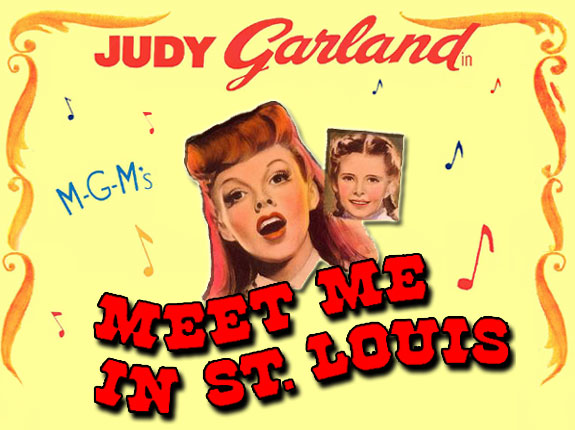
|

 
Click here to
read about author Sally Benson and the origins of the story.
MGM purchased the screen rights to Sally Benson's "Kensington
Stories" for $25,000.00 on March 1, 1942. Right away,
the story went through the screen writing process at MGM.
Several screen writers and authors took a stab at it. Sally
Benson herself worked on what became a 198 page treatment
written with Doris Gilbert between March 30 and May 9, 1942.
Between April and October 1942, other writers worked on the
project, including the husband-and-wife team of Victor Heerman
& Sarah Y. Mason (Oscar winners for their 1933 adaptation
of Little Women) and William Ludwig, who had written
for the Andy Hardy series and also Margaret O'Brien's Journey
For Margaret (1943).
None of these treatments seemed to work, and finally Irving
Brecher & Fred Finklehoffe were given the assignment.
Finklehoffe had written for several Judy Garland musicals,
and Brecher had written for the Marx Brothers, which seemed
at first an odd choice to write a delicate family story.  Finklehoffe
and Brecher wisely decided that the bulk of the story should
take place in the Smith family home and it's surrounding area
of St. Louis. It was Finklehoffe and Brecher who expanded
the "Warren Sheffield telephone call from New York"
scene by making Mr. Smith ignorant to the goings on and having
him hang up the phone when it first rings. They also took
out scenes at Princeton University and a Smith family visit
to their grandparents in Manitowoc, Wisconsin. Finklehoffe
and Brecher wisely decided that the bulk of the story should
take place in the Smith family home and it's surrounding area
of St. Louis. It was Finklehoffe and Brecher who expanded
the "Warren Sheffield telephone call from New York"
scene by making Mr. Smith ignorant to the goings on and having
him hang up the phone when it first rings. They also took
out scenes at Princeton University and a Smith family visit
to their grandparents in Manitowoc, Wisconsin.
Some other changes made were: Moving Mr. Smith's decision
NOT to move the family to New York from immediately after
the family's objections to the night before the planned move(Christmas Eve) heightening the tension; Removing a romance
between Rose and Colonel Andrews (renamed Darly in the final
film) -only a small scene remains that hints of Rose's attraction
to him;Removing an announcement by Tootie that she did not
want to go to the fair; Changing the hair color of Rose and
Esther from blonde and black to both being auburn; Removing
a blackmail subplot involving Esther and finally, they divided
the film into four segments representing the four seasons
of the year (Sally Benson's book had been 12 chapters, one
for each month of the year).
Name changes were made too, sometimes for legal reasons.
Sally Benson wanted Lucille Ballard's name to be either Picard
or Dorsey. John Truett began life as John "Bluett," then for legal
reasons became Collins, then Truett (Ms. Benson objected
to
"Truett"). "Bluett" stayed as the reference name of the house on MGM's "St. Louis Street" even after the backlot was torn down. Warren Sheffield originally was named
Warren Sheppard, and for legal reasons the Waughops became
the Braukoffs. The real life name of the maid was indeed Katie,
and the real-life Katie was alive and well and provided a
signed release to the MGM legal department, giving the "ok"
to use her name.
Finally, here are some interesting additions, changes, and/or
deletions from the original book: The ketchup tasting scene
that opens the film is an very expanded version of a simple
paragraph in the book; In the book Rose gets mixed up with
a middle-aged man; Mrs. Smith loses her temper; Tootie's ride
on the ice wagon was originally a ride on a water-sprinkler;
The cakewalk scene is danced in the book by Agnes, in a man's
hat (Sally Benson based the Agnes character on herself); The
Halloween sequence is in the book although it's Agnes who
takes on the Braukoffs (or Waughops); A slight reference in
the March segment of the book to a trolley gave birth to the
entire "Trolley Song" sequence; The scene of Tootie
and Agnes coming down the stairs during Lon's farewell party
and Tootie singing "I Was Drunk Last Night" also
comes from the book; Mr. Smith's decision to move the family
to New York, and the subsequent tension it creates for the
final half of the film, is from a small three-page episode
in the book; and finally, it's Agnes who ends the book by
saying "I can't believe it. right here where we live.
Right here in St. Louis".
With the script in place, producer Arthur
Freed turned to Hugh Martin and Ralph Blane to compose
the original songs for the film. At the time, Martin and Blane
had enjoyed moderate success with their successful Broadway
show "Best Foot Forward".The property was bought
by MGM, so Martin and Blane, along with stars Nancy Walker,
Tommy Dix and Gil Stratton, were brought out to MGM to adapt
the show for the screen. Martin and Blane also contributed
to other films including "Three Cheers For The Yanks"
to For Me And My Gal (1942) starring Judy Garland.
Still, they hadn't obtained the success they wanted so Meet
Me In St. Louis was their big chance. Freed felt strongly
enough about their abilities to ask them to write new songs
for Meet Me In St. Louis, to help complement the use standards
of the day. They would end up providing four songs for the
film, three of which would be the best of their careers and
have since become classic standards ("The Boy Next Door",
"The Trolley Song", and "Have Yourself A Merry
Little Christmas").
Freed also took a chance on hiring Vincente Minnelli to direct.
At first Minnelli seemed like an odd choice to helm such a
costly and risky project.  Although to Freed, it probably seemed
like the logical choice. Known for his use of composition
and his unusual flair for design, Minnelli was an inspired
choice. Minnelli had directed I Dood It (1942) starring
Red Skelton, and most notably Cabin In The Sky (1943)
starring Ethel Waters and Lena Horne. Click
here for a biography of Vincente Minnelli. Although to Freed, it probably seemed
like the logical choice. Known for his use of composition
and his unusual flair for design, Minnelli was an inspired
choice. Minnelli had directed I Dood It (1942) starring
Red Skelton, and most notably Cabin In The Sky (1943)
starring Ethel Waters and Lena Horne. Click
here for a biography of Vincente Minnelli.
Many at the studio felt the story had not plot and that the
film would be a flop. It was even referred to by some as "Freed's
Folly". But Freed stood by his choices and went about
the tasks of pre-production on the film, including the casting
of the major roles.
When
Judy Garland first discovered that MGM was going to cast her in their
new musical film entitled Meet Me In St. Louis she was not happy.
She feared, and with good reason, that the film would set her career
back. She had finally been allowed to grow up on the screen. In For
Me And My Gal (1942) she was given a real romantic lead in newcomer
Gene Kelly, and she was the undisputed star of the film, with her name
alone above the title for the first time.
After
that she appeared in Presenting Lily Mars which was the first time
the studio made a real effort to make her look glamorous, even if it was
mainly for the finale at the end of the picture. She was seen for the first
time with her hair up and looking quite beautiful. True, she had also just
completed Girl Crazy (1943) as well, but even in that, her final complete
film with Mickey Rooney, she was a completely different character than in
all of the other Garland/Rooney pictures. In this film, Mickey chased Judy
rather than the other way around, and she was portrayed not as a teenager
deep in puppy love, but as a lovely young woman.
Now, after reading the St. Louis script, it appeared as though
the studio wanted her to revert back to playing a high school girl with
a crush on the boy next door. Judy was dating Joe Mankiewicz at the time, and he was also instrumental
in allowing her to see herself as not just a little girl with a big voice,
but a desirable woman. At 22 years of age, Mankiewicz reasoned, Judy Garland
had the talent and ability to graduate to more adult roles. And Judy not
only agreed with it, but with Mankiewicz in her corner, for the first time
she summoned up the strength to actually resist the studio for her own
benefit.
Judy went to L.B. Mayer and complained, and for once he sided with her.
He went to producer Arthur Freed to discuss the matter, but was effectively
swayed in the other direction by Freed, director Vincent Minnelli, and
most importantly the reigning studio storyteller Lillie Messinger.  Once
Lillie got a hold of a story, no one was immune. She was able to effectively
point out the charms and magic of the story. Mr. Mayer loved a good sentimental "all-American"
story and this had everything he loved. Next Judy went to see Minnelli
on her own, thinking that she might be able to persuade him, since she
was one of MGM's biggest stars, and he was a novice director. Once
Lillie got a hold of a story, no one was immune. She was able to effectively
point out the charms and magic of the story. Mr. Mayer loved a good sentimental "all-American"
story and this had everything he loved. Next Judy went to see Minnelli
on her own, thinking that she might be able to persuade him, since she
was one of MGM's biggest stars, and he was a novice director.
Minnelli had directed only two films before, neither was a big financial
success. The best of the two, Cabin In The Sky, although a beautiful
film that critics liked, was an all-black film and in 1943 that meant a
limited audience. Judy was sure that not only would St. Louis be
a mistake but that she could persuade Minnelli that it really wasn't very
good!
In
his memoirs, Minnelli reports what happened when Judy came to see him
about the film: "She looked at me as if we were planning an armed
robbery against the American public. She later told me that she'd come
to see me thinking I would see it her way." Per Minnelli,Garland
says "It's not very good, is it?" to which Minnelli responded
with "I think it's fine. I see a lot of great things in it. In fact,
it's magical."Whether years later the exact words of the conversation
are remember by Minnelli is immaterial. Judy may have been going on an
early draft of the screenplay which was, according to most accounts,
not very good. But it was shaped up by the time rehearsals began. And
since Mayer switched and sided with Freed, and Freed stood behind Minnelli,
Judy had no choice but to acquiesce. Rehearsals began on November 11,
1943 and Judy did not exactly throw herself into the role. She was used
to the more contemporary, "wise cracking" dialog.
When filming began almost a month later on December 7, 1943 things weren't
much better. In fact, it's reported that when Minnelli was away from the
set, Judy would sometimes entertain the cast and crew with a devilishly
satire of Minnelli centered around his "perfectionism." This
skit would entail her acting out the part of an MGM bit actor who is paid
his set fee to say one line in every film in production: "I think
it may rain today." The bit actor comes to the Minnelli set fully
expecting to say his line, collect his pay, and leave. But Minnelli (again
acted by Judy) has other things in mind and suggests the actor try saying
his lines with a different inflection. Taken aback, the actor tries it
that way. The Minnelli suggests a different way, then another and yet another
until finally the bit actor is reduced to tears of frustration and confusion.
This
story illustrates how funny Judy could be when she wanted to be (her wit
is legendary in Hollywood and she was known as the perfect mimic). This could
also be seen as her way of dealing with a situation of which she had no control
and was not happy about. Judy had a practically photographic memory when
it came to lyrics and script, and she resented Minnelli's constant rehearsals
and multiple takes.Judy usually got her lines and hit her marks perfect
the first time. But with Minnelli, not only was he insisting that she rehearse
and endure long, multiple takes (he didn't like the idea of using the stand-in
for much of this), but he was breaking down her confidence. He was exacting
but in a quiet way. Her frustration grew as she began to question her merits
as an actress, feeling like she wasn't doing anything right. She went to
Freed to complain, who told her to bide her time and give him a chance. She
also reportedly complained to Mary Astor, who flatly said to Judy: "Just
go along with it, he knows what he's doing."
Things got a little better, but didn't really get on track until Judy began
to see herself on film. Suddenly, under his direction, Judy not only looked
more beautiful and vibrant than ever before, but Minnelli was getting a
beautifully realized understated performance from her. And whatever qualms
she had about being a "teenager" or lost in the ensemble were
put to rest as well. Soon Judy was entrusting Minnelli with her trust.
But that trust came with a price.
Judy would be absent from the set of St. Louis for close to 3
weeks. Initially this was due to a lack of interest in the project. But
aside from that,  Judy was beginning to show signs of the strain that the
previous years of overwork, malnutrition, and medications had caused. She
was going through the ups and downs that addicts begin to experience when
the drugs begin to take over. Judy was never a morning person, having been
raised in a Vaudeville atmosphere of late nights and late mornings. But
at MGM, she was expected to be at the studio usually at 5 or 6am. And she
had other commitments as well: Radio appearances; Personal appearances
for the war effort; and making records for Decca Records. All of this,
added to her fragile psyche and her low self esteem, created a time bomb
ticking away just waiting for the time to explode. Judy was beginning to show signs of the strain that the
previous years of overwork, malnutrition, and medications had caused. She
was going through the ups and downs that addicts begin to experience when
the drugs begin to take over. Judy was never a morning person, having been
raised in a Vaudeville atmosphere of late nights and late mornings. But
at MGM, she was expected to be at the studio usually at 5 or 6am. And she
had other commitments as well: Radio appearances; Personal appearances
for the war effort; and making records for Decca Records. All of this,
added to her fragile psyche and her low self esteem, created a time bomb
ticking away just waiting for the time to explode.
Mankiewicz
saw this and suggested she go to therapy to help solve her deep emotional
issues and restore her self worth. She agreed and went. But when the studio
found out, they put a stop to it - not believing that one of their stars
was "crazy"
(the world of psychoanalysis in the 1940's was still considered suspect
and charlatan by nature). In a few short years the studio would find themselves
paying for Judy to continue treatment.
Beginning in 1943 and ending in 1947, Judy Garland changed from a nervous
insecure young lady to a glowing, confidant woman in command of her talent
and happily exploring and learning all avenues of that talent, then back
again to an insecure young lady. The rise in happiness can be partly attributed
to Minnelli, Meet Me In St. Louis, Kay Thompson and the rest of
the legendary "Freed Unit." Everything that made the "Freed
Unit" so special first burgeoned with Meet Me In St. Louis.
Arthur Freed had been assembling a platoon of personnel, mostly from Broadway,
to populate his little kingdom. These people were bright, young and talented
individuals who would change the look and style of the movie musical forever.
For Judy Garland, being in this atmosphere was exciting and exhilarating.
She was allowed to flourish and experiment with all aspects of her performing.
Minnelli was perfect at this time to help guide her into his world of savvy,
articulate and witty people. She loved it. And she would do some of her
best work during this time and was, for the most part, quite happy. Judy
and Minnelli began dating towards the end of production of Meet Me In St.
Louis, and although many people thought the union was all wrong, for
Judy it was the right man at the right time. At least as far as her career
goes. Kay Thompson was a new addition to the Freed Unit, one of the many
transplants from Broadway. Kay would take Judy under her wing and develop
her singing style even further than her mentor, Roger Edens had. This would
be Judy's closest friendship to any woman in her entire life. Kay had a
sophistication and style that was classy, brassy, and highly stylized.
Judy thrived.
The
affair with Joe Mankiewicz over (he had evidently gone to the studio to argue
that Judy needed professional psychiatric help and ended up walking out on
his contract because Mayer and Judy's Mom wouldn't listen), Judy put all
of her energies into St. Louis and her relationship with Minnelli.
The end result is several wonderful performances given by Judy, most of them
under Minnelli's direction.
Judy Garland wasn't the only performer on the set causing problems. If
you look at the timeline to this site, you'll see in great detail the constant
barrage the company was under due to one illness or accident after another. As with so many films, accidents happen. St. Louis was no exception.On March 31, 1944 one of the extras suffered a hit on the head by one of
the light standards (Click here to read about it). A cameraman was hit on the head with a piece
of carbon. Joan Carroll had to be sent back to wardrobe (which on a lot
the size of MGM could amount to a long trek) because she was given two
right shoes to wear. Harry Davenport was 77 and was doing double duty on
the set of Kismet so was ill and/or away from the set frequently.
One memo states: "Wait for Margaret's hair to be dressed - wrong hair-do
because script clerk did not give right hair change to hairdresser." Both
Margaret and Joan Carroll (Agnes) were underage so had to be schooled for
3 hours with 1 hour of "recreation."
This was California law, MGM would get around it as best they could. Their
teacher, who was on the set at all times, was reportedly a formidable woman
who had no qualms stopping the production because either Margaret should
go home or in on instance, that it was simply too late for Joan Carroll
to continue working.
Mary Jo Ellis, one of the cast members, had to be taken home due to fainting.Several cast members would be sick at one point or another. It should be
pointed out that on a sound stage such as they had at MGM in the 40's,
and before good air conditioning, a balmy set would be a breeding place
for cold/flu germs to hop from one person to the next. Especially since
half their time was sitting around waiting for the director to set everything
up for a few takes.  They would entertain themselves as best they could. They would entertain themselves as best they could.
But
those were the least of the problems that seemed to plague the set of Meet
Me In St. Louis. This film seemed to be the "sickest" film
on the lot - with practically everyone coming down with some sort of illness
- real or imagined.
Real: Joan Carroll's appendectomy. On February 2, 1944 shooting is halted
as Joan is rushed to the hospital. The "ever so caring" studio
places Joan on suspension - even though Arthur Freed sends her flowers
and she sends him a "thank you" note.
This
seemingly callous treatment may have been caused by recent events with the
OTHER child actress on the set - Margaret O'Brien. Margaret's mother is convinced
that the studio is working her daughter way too hard. So on January 31, 1944
a two week period began without Margaret. Her mother feigned illness as the
cause, originally. But as you will see in this letter from Margaret's mother,
her absence was really a mother protecting her child, not illness: Click here to read the "apology" from Margaret's mother which arrived
some time after their departure. Margaret's mother had decided (with justification)
that the studio had been working her daughter too hard - so she took it upon
herself to take the child away from the studio for a few weeks. Naturally
this caused quite a stir at the studio - upset the production schedule, and
added thousands of dollars to the budget (click here to
read memo by Dave Friedman dated this day which begins the "layoff"
of the company due to Margaret O'Brien's unscheduled absence which last
through early February and click here to read related memo). The
children weren't the only ones causing delays due to illness, Mary Astor
and Harry Davenport were both ill as well - and as noted on the previous
page, many delays were caused by accidents (which was normal for any film).
And there you have it - Minnelli's first chance to show what he can do
as a director - which he does to meticulous detail!
Minnelli's use of color and movement in the film is nothing short of
genius. In an interview, he stated "You have to have great discipline
in what you do. I spent a great deal of time in research, and finding
the right things for it. I feel that a picture that stays with you is
made up of a hundred or more hidden things."
This is apparent upon repeated viewings of the film. There are so many
little things filling out the backgrounds - yet they blend in naturally
so as not to look to over done. Take Grandpa's room. Now here is a "man's" room
of the time. Filled with muted colors and all kinds of masculine brick-a-brack.
Minnelli raided the MGM props and costume departments, looking for just
the right things with which to clothe them and surround them. He also
worked closely with art director Jack Martin Smith; set decorators Edwin
B. Willis & Paul Huldchinsky; costume designers Sharaff and Irene;
as well as Jack Dawn on make-up and of course George Folsey on photography.
In fact, Minnelli was such a perfectionist that he drove practically
everyone crazy! He would take hours making sure the set was perfect,
the camera angles/movements were perfect - THEN get to the actors. At
which time he would rehearse and rehearse with them until he found everything
to be perfect, then filming would finally begin.
This
was especially maddening for Judy. Judy had just this side of a photographic
memory. People still speak with awe about the way in which she could read
a script for the first time and speak it like she had rehearsed it for months.The same with music. She would hear a song once or twice on the piano, then
sing it right back to the composer. A TRUE natural talent. So, just like
the kid in school who's to "fast" for the class, so Judy was too "fast"
for Minnelli. And it drove her crazy. She would try to get out of the
studio, only to be stopped at the studio gate by Minnelli and summoned back to the set for
more rehearsals. A TRUE natural talent. So, just like
the kid in school who's to "fast" for the class, so Judy was too "fast"
for Minnelli. And it drove her crazy. She would try to get out of the
studio, only to be stopped at the studio gate by Minnelli and summoned back to the set for
more rehearsals.
Although
it seems that the production was mired in chaos, there were wonderful times
too. Once Judy saw herself in the dailies she realized that not only was
Minnelli making her the most beautiful she had ever been, but he was also
making a beautiful and touching film.
The credit for Judy's new appearance doesn't belong solely to Minnelli.
The bulk of the credit goes to "Dottie" Ponedel. Minnelli had specifically asked
for "Dot" to be Judy's make-up artists. This was a first at the
time. Up to this time, all of the major make-up artists who worked on the
stars were men. Sure, there were women assistants, but never before had
one woman been given the task of making up a star of Garland's caliber. It was Dottie who was responsible for Judy's beautiful new look as shown
for the first time in Meet Me In St.
Louis. Dottie was a "no nonsense" type of person, and
it's been reported several times that if there were no cup of water around,
Dottie would simply dip her make-up brush in the nearest cup of coffee
and continue! Meet
Me In St. Louis was the first time Judy and Dottie worked together.
Dottie reportedly looked at Judy's inserts for her nose and said "What are those?"
When Judy told her, Dottie said "Throw them out, you don't need all that
junk, you're a pretty girl." It was Dottie who gave Judy the new look
that would last the rest of her career. From this moment on, Judy insisted
that only Dottie would do her make-up in all of her subsequent films.
As Judy's appearance blossomed so did her acting. Although still a high
school girl, the role of Esther Smith is light years away from the characters
Judy had previously played. Instead of a peppy "teen" or "juvenile",
Esther Smith is a young lady on the verge of womanhood. And Judy plays her with
a subtleness and a sort of softness that effectively makes you believe that this
character is real. That her emotions are real. Even though the film is a "musical"
there are many wonderful scenes that rely on Judy's incredible comic timing.
Once again, very subtle and never once forced. This is the film in which
Judy completes her transition to mature leading lady. From here on out,
Judy would always be presented as a beautiful and desirable woman.
Meet Me In St. Louis has a look and feel all its own. Minnelli and his
crew took great care in creating this singular palette. For the scene in which
Esther and John go through the house turning out the lights, Minnelli went to
great pains in creating just the right mood. To achieve the right multiple lighting
effects when Esther and John turn out the lights, Minnelli had the technicians
use everything from conventional dimmers to actual window blinds. The scene is
beautifully effective in showing the deepening of Esther and John's romance as
the rooms slowly darken.
A very happy accident occurred when filming the lights from the kitchen
beaming onto the nighttime snow. The scene is Esther and Tootie looking
out the window on Christmas Eve, just before Esther sings "Have Yourself A Merry Little
Christmas", and there is a quick shot of the back yard. This beautiful
shot actually was an accident. When it was filmed by the Assistant Director,
the word came back from the lab that film wasn't exposed properly. Happily,
the beauty of the scene remained intact.
Meet
Me In St. Louis had
it's first preview on June 5, 1944 and a second on July 3, 1944. And
that's when more heartache came in. Some executives at the studio wanted
the entire Halloween sequence cut - they thought it slowed down the picture
and didn't have anything to do with the plot. In a sequence of events reminiscent
of "Over
The Rainbow"
in The Wizard Of Oz, Minnelli and Freed fought to keep the sequence
in.  Arguing, as Minnelli would state later, that the sequence actually
underlined the entire crux of the story - the reason WHY this family
would want to stay in St. Louis - it was their HOME. No argument came
of the cutting of "Boys
And Girls Like You And Me." It was decided that either that or "The
Boy Next Door" should be cut - and since "The Boy Next Door" advanced
the plot, whereas "Boys And Girls" really didn't, there was no contest.
Martin and Blaine were pleased, fearing that the Rodgers & Hammerstein "Boys
And Girls" would get all of the attention, leaving the songs by the "relatively
unknown" songwriters in the background. Luckily, this wasn't to
be. Arguing, as Minnelli would state later, that the sequence actually
underlined the entire crux of the story - the reason WHY this family
would want to stay in St. Louis - it was their HOME. No argument came
of the cutting of "Boys
And Girls Like You And Me." It was decided that either that or "The
Boy Next Door" should be cut - and since "The Boy Next Door" advanced
the plot, whereas "Boys And Girls" really didn't, there was no contest.
Martin and Blaine were pleased, fearing that the Rodgers & Hammerstein "Boys
And Girls" would get all of the attention, leaving the songs by the "relatively
unknown" songwriters in the background. Luckily, this wasn't to
be.
The film had it's official premiere in St. Louis, Missouri on November
22, 1944. Running 113 minutes, it was a smash! No one objected to the
Halloween Sequence, and audiences everywhere fell in love with the Smiths
of S. Louis.Judy Garland's status went from "star" to "superstar" -
and there was no denying that while Margaret O'Brien was cute and funny
and quite the scene stealer - the REAL star of the picture was Judy.
Now, in her first color film since The
Wizard Of Oz (and one song in Thousands Cheer in 1943), Judy Garland
blossomed into a beautiful, talented young woman - the epitome of what young
girls everywhere wanted to be - and what the boys overseas were fighting for.
When
it was released in 1944, Meet Me In St. Louis became an instant hit,
and was MGM's biggest grossing film to date after Gone With The Wind.
However it must be noted that Gone With The Wind was actually a David
O. Selznick production that MGM owned the release rights to, and would eventually
own the entire film. Meet Me In St. Louis was 100% an MGM production.
The film would go on to be nominated for 4 Academy Awards: Color Cinematography
-- George Folsey ; Scoring of a Musical Picture -- Georgie Stoll; Song "The
Trolley Song" -- Music and Lyrics by Ralph Blane and Hugh Martin; and
Screenplay -- Irving Brecher, Fred F. Finkelhoffe . It wouldn't win any Oscars,
but it did win a lasting fame and place in film history that few films of
1944 would be able to achieve.
Among other things, the film has one of Judy Garland's three best film performances
(the other two being The Wizard of Oz and A Star Is Born).
It's also considered one of, or THE, best efforts of many of the people involved.
It's the film that launched Vincent Minnelli on his stellar directing career
as the greatest director of film musicals. It broke new ground as an "integrated"
musical - and in doing so, paved the way for further experimentation and freedom
for Arthur Freed and the "Freed Unit" - this unit at the studio would
be responsible for practically ALL of the great musicals of the 1940's & 1950's.
 Both Judy and Margaret O'Brien would reprise their roles in a radio version of
the film for CBS Radio in 1946 - and in 1947 Judy would join the AFRS (Armed
Forces Radio Show) Show Time Players in performing a version of Meet Me In
St. Louis for the "Show Time" radio program. Both Judy and Margaret O'Brien would reprise their roles in a radio version of
the film for CBS Radio in 1946 - and in 1947 Judy would join the AFRS (Armed
Forces Radio Show) Show Time Players in performing a version of Meet Me In
St. Louis for the "Show Time" radio program.
The film would inspire imitations - Summer Holiday (another Freed effort
in 1948); On Moonlight Bay & By The Light Of The Silvery Moon (both
Doris Day vehicles atWarner Bros and both with Leon Ames as the father, and
a cast of characters almost identical to St. Louis).As charming as those film are, none have that
special magic that Meet Me In St. Louis has. Like all great cornerstone films
of any genre, Meet Me In St. Louis was the right people in the right place
at the right time making the right film. Two Broadway versions of the film, in
1960 and 1988, would be popular - as are the various touring companies that have
brought the film to the stage - but in all cases, the film is so indelible that
comparisons are always made (and usually not in favor of the stage version!).
Now, more than 50 years after its release, Meet Me In St. Louis continues
to work it's magic on audiences of all ages.
Over the
years, Meet Me In St. Louis has remained one of the best film
musicals ever made. Gene Kelly would always call it "my favorite musical".
Today, the film still has resonance and power. This is due to its simple
themes of family and home. Made during a time when America was embroiled
in World War Two, and so many families didn't know if their loved ones
would come home, the film gave them hope in lovingly looking back to an
era that even then was a distant memory.
Now, 100 years after the era it portrays, Meet Me In St. Louis still
grabs us and makes us believe in the idealized world of the Smith family of St.
Louis, Missouri. And even today there are precious few films that can so expertly
give us that special warm feeling that Meet Me In St. Louis still gives.
A true American classic that will last as long as people want to see good, quality
entertainment.
 
top of page
| 

|
|
|
| 06/14/1941 |
"The
New Yorker" magazine runs part one of eventually
8 installments of short stories written by Sally Benson
entitled "5135 Kensington" the eighth and
final installment appears May 23, 1942. |
| 01/06/1942 |
Lily
Messenger provides an initial screen treatment of
the stories to MGM Studios boss Louis B. Mayer. Ms.
Messenger is instrumental in getting Mayer to support
the making of the film. People at the studio balked
that there was no plot, but after "MGM's Scheherazade"
(Lily) vividly described the story, Mayer was enchanted. |
| 03/01/1942 |
MGM
purchases the screen rights (as well as the radio
and, interestingly enough, the television rights)
to the "Kensington Stories" for $25,000.00.
The purchase date could be much earlier, in May of
1941 as some reports give Arthur Freed credit with
reading the stories provided to him by Fred Finklehoffe
while in the office of Leland Hayward (the famous
show business agent) BEFORE publication in "The
New Yorker" magazine. According to the legend,
Freed is so taken with the stories, that he immediately
gets on the phone and negotiates their purchase. (date
is approximate) |
| 3/30/42
thru 5/9/42 |
Author
Sally Benson, collaborating with Doris Gilbert, produces
a 198 page screen treatment of the stories, followed
by additional supplemental material. During this time,
Ms. Benson takes the original stories, adds 4 more
chapters so each chapter represents one month of the
year from January - December, 1903 and 1904 - and
then publishes them as a book by Random House as "Meet
Me In St. Louis" - this is the first time the
title of the film is associated with the stories.
MGM of course has the rights to the book as well. |
| April
thru October 1942 |
Screenwriters
who work on the script during this time include: Husband
& wife team of Victor Heerman & Sarah Y. Mason
(who jointly won the 1933 screenplay Oscar for "Little
Women"), William Ludwig (who wrote the screenplay
to Margaret O'Brien's immensely popular "Journey
for Margaret") and even director George Cukor,
who after a few months of work starting from scratch,
was drafted into the Army and so the project was shelved,
temporarily. |
| 04/30/1943 |
Irving
Brecher & Fred Finklehoffe provide a "rough
continuity outline" of the screenplay followed
by a draft of the screenplay. |
| 05/22/1943 |
Arthur
Freed signs the final shooting script as "complete". |
| 06/10/1943 |
Judy
Garland's 21st Birthday - this is important because
Garland did not want to play Esther. In her previous
few films, she was finally being allowed to "grow
up" a little on screen, and playing the teenage
Esther, in her eyes and those of many around her,
would be a backwards step for her career. Her reluctance
would cause a rocky start once rehearsals and production
begins. |
| 07/16/1943 |
After
Brecher worked on the script alone adding additional
supplemental material, the final screenplay is completed.
Total cost to MGM for all the work on the script is:
$86,616.67 |
| 07/30/1943 |
Letter
dated 7/29/43 is delivered to MGM from Joseph I. Breen
of the Hays Censor Office. Click here to read the memo. |
| 11/03/1943 |
Arthur
Freed and singer Denny Markas pre-record "You
and I" for Leon Ames & Mary Astor to lip
sync to. |
| 11/11/1943 |
Rehearsals
begin. |
| 11/11/1943 |
Meet
Me In St. Louis goes into production as Production
No. 1317. It is budgeted at $1,536,971.93 with a shooting
schedule of 58 days. Included in the budget are the
following:
$151,575 to build the new "St. Louis Street"
$62,225 for the lower floor of the Smith home
$16,625 for the miniature of the exterior of the World's
Fair
$15,625 for the trolley depot
$5,091 for the trolley tracks |
| 12/01/1943 |
Judy
& cast pre-record "Meet Me In St. Louis". |
| 12/02/1943 |
At
8:45pm, Judy & chorus and 41-man band pre-record
"The Trolley Song" (which is Scene 90 in
the shooting script). |
| 12/03/1943 |
Judy
& Lucille Bremer pre-record "Meet Me In St.
Louis" (duet version). |
| 12/03/1943 |
Judy
& cast pre-record "Skip To My Lou". |
| 12/04/1943 |
Judy
pre-records "The Boy Next Door". |
| 12/04/1943 |
Judy
pre-records "Have Yourself A Merry Little Christmas". |
| 12/06/1943 |
An
"R. Monta" sends a memo to Arthur Freed
relaying some story changes suggested by author Sally
Benson. Click here to read the memo. |
| 12/07/1943 |
Principle
photography begins. |
| 12/11/1943 |
In
a memo, Arthur Freed gives final approval for the
following name changes Lucille Ballard (was to be
surname of Picard or Dorsey) John Truett (was to be
Bluett or Carson - author Benson objects to "Truett")
Warren Sheffield (was to be Sheppard) Mr. & Mrs.
Braukoff (was to be Waughop) Note: The Smith's real-life
maid Katie gives her approval to MGM to use her name! |
| 12/17/1943 |
Judy
& Margaret O'Brien pre-record "Under The
Bamboo Tree." |
| 12/18/1943 |
Judy
arrives late for St. Louis filming, meets with
producer Arthur Freed, then leaves at approximately
10:30 am not feeling well. Click here to read memo. |
| 12/30/1943 |
Judy
absent from filming of St. Louis due to illness
- Memo reads "Judy Garland is still ill, and
Company worked around her until 12 noon today. The
balance of the day was spent in rehearsing musical
number." |
| 01/12/1944 |
Judy
absent from filming of St. Louis due to illness.
Click here to read memo. |
| 01/20/1944 |
1:20pm
- Margaret O'Brien's dental plate comes loose and
she's sent to the dentist. Click here to read the previous memo detailed the beginnings
of Margaret's dental problems and absences from the
set. |
| 01/24/1944 |
"Under
The Anheuser Bush" instrumental recorded (this
is to be part of the underscoring of the "Christmas
Party" sequence). |
| 01/28/1944 |
Click here to read memo detailing Mary Astor's bouts
with the flu. |
| 01/31/1944 |
Click here to read memo by Dave Friedman dated this
day which begins the "layoff" of the company
due to Margaret O'Brien's unscheduled absence which
last through early February. Click here to read related memo.
Click here to read the "apology" from Margaret's
mother which arrived some time after their departure. |
| 02/02/1944 |
Shooting
is stopped for several days due to Joan Carroll (Agnes)
being rushed to the hospital on this day for an emergency
appendectomy. MGM callously suspends her salary during
the time she is away from the set. However, Arthur
Freed sends her flowers and "well brought up
young lady" that she is, she sends him a "thank
you" note! Click here to read memo. |
| 02/14/1944 |
Click here to read from daily production log of this
date detailing Judy Garland's frequent lateness &
absence. |
| 02/15/1944 |
"Margaret
O'Brien was available for work today" is reported
in a memo - shooting resumes. |
| 02/29/1944 |
Click here to read memo detailing Joan Carroll's bout
with the sore throat and flu that seemed to be "popular"
amongst the cast. |
| 03/01/1944 |
Judy
absent from filming of St. Louis due to illness -
Click here to read memo (Due to this and Joan Carroll's
absence, the company is laid off again). |
| 03/03/1944 |
Beginning
at 8:43pm, the "Halloween Sequence" is filmed.
A lunch from 11:45pm - 12:45am is reported. From 11pm
through 11:32pm there is a break in filming for Minnelli
to discuss "change in set up to give more eerie
effect." The filming finally finishes early 3/4/43
at 4:55am. |
| 03/09/1944 |
Judy
absent from filming of St. Louis due to illness.
Click here to read memo. |
| 03/20/1944 |
Company
waits for "Perfume bottle (special container
with satin lining asked for by Director)" (from
daily production log) - the company waits until 3/26/44
for the bottle. This is a perfect example of Minnelli's
quest for perfection. |
| 03/23/1944 |
Judy
absent from filming of St. Louis due to illness.
Click here to read memo. |
| 03/31/1944 |
Report
by Assistant Director Dave Friedman tells of one of
many accidents to happen during filming. Click here to read memo. |
| 04/01/1944 |
Click here to read from daily production log of this
date detailing more of Judy Garland's frequent lateness
& absence. |
| 04/01/1944 |
Judy
signs new three year contract with Decca Records. |
| 04/01/1944 |
Click here to read entries from the daily production
log detailing Minnelli's perfection in the composition
of a scene - one that never makes it to the final
print! |
| 04/07/1944 |
Filming
is completed and the production is closed. Total cost:
$1,707,561.14 ($170,589.21 over budget) Filming lasts
an actual 70 days (12 days over schedule). |
| 04/20/1944 |
Judy
records "Boys And Girls Like You And Me"
for Decca records. |
| 04/20/1944 |
Judy
records "Have Yourself A Merry Little Christmas"
for Decca Records. |
| 04/20/1944 |
Judy
records "The Boy Next Door" for Decca Records. |
| 04/21/1944 |
Judy
records "Meet Me In St. Louis" for Decca
Records. |
| 04/21/1944 |
Judy
records "Skip To My Lou" for Decca Records. |
| 04/21/1944 |
Judy
records "The Trolley Song" for Decca Records. |
| 05/17/1944 |
Judy
sings "The Trolley Song" on the "Mail
Call" (#91) radio program. |
| 05/25/1944 |
Underscoring
for the film begins with Conrad Salinger conducting.
Some of the sections recorded on this day are: The
"Main Title" (w/the MGM Studio Chorus);
The Halloween Sequence; & the "I Hate Basketball"
scene. |
| 05/26/1944 |
Judy
pre-records "Over The Banister". |
| 05/26/1944 |
Underscoring
for the film continues with Conrad Salinger conducting.
Some of the sections recorded on this day are: The
"Getting Ready for the Party" scene; scene
with Esther & John turning out the lights (including
Judy's vocal of "Over The Banister"; "Tootie's
Music Box"; "Tootie's Grief"; &
the "Finale". |
| 05/27/1944 |
Underscoring
for the film continues with Conrad Salinger conducting.
Some of the sections recorded on this day are: Opening
of the Winter section; Esther's acceptance of John's
proposal after the Christmas Party. |
| 06/04/1944 |
Judy
sings "The Trolley Song" on the "The
Bakers of America Salute to the Armed Forces"
radio program. |
| 06/05/1944 |
First
preview. |
| 06/10/1944 |
Judy
Garland's 22nd Birthday. |
| 06/25/1944 |
Judy
sings "The Boy Next Door" on "The Chase
and Sanborn Hour" radio program. |
| 07/03/1944 |
Second
preview - cuts were made after this, including the
deletion of "Boys And Girls Like You And Me." |
| 07/14/1944 |
Arthur
Freed writes a letter to Rodgers & Hammerstein
about the deletion of their song "Boys And Girls
Like You And Me" - Mr. Freed states "The
entire sequence the song was part of was eliminated
after the preview on account of its length." |
| 10/08/1944 |
Judy
sings "The Trolley Song" on the "Hollywood
Democratic Committee Dinner" radio program. |
| 11/02/1944 |
|
| 11/22/1944 |
Meet
Me In St. Louis premieres in St. Louis, Missouri
- the running time of the film is 113 minutes. |
| 12/17/1944 |
Judy
performs "The Trolley Song" & "Have
Yourself A Merry Little Christmas," for Philco
Radio Hall Of Fame. |
| 04/23/1945 |
Judy
Garland and Kay Thompson are recorded in the MGM Recording
Studios singing an impromptu duet of "In The
Valley When The Evening Sun Goes Down" (Judy's
opening number to The Harvey Girls). This
is the only know recording of these two great friends
singing together. |
| 03/01/1945 |
At
Grauman's Chinese Theater in Hollywood, Meet Me
In St. Louis is up for 4 Oscars in the 17th annual
Academy Awards presentation: Cinematography (Color)-George
Folsey; Music (Scoring of a Musical Picture)-Georgie
Stoll; Music (Song "The Trolley Song")-Ralph
Blane & Hugh Martin; Writing (Screenplay)-Irving
Brecher & Fred F. Finkelhoffe. It would win none. |
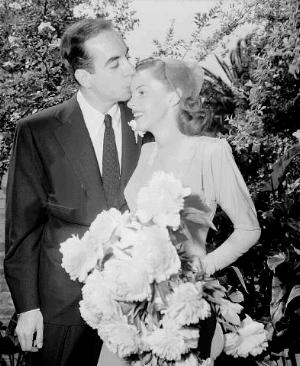
| 09/17/1945 |
Judy
marries Vincent Minnelli - studio boss Louis B.
Mayer gives the bride away. Vincent would direct Judy
in her guest appearances for "Ziegfeld Follies,"
and "Till The Clouds Roll By," as well as
the films "The Clock" and "The Pirate."
Although Vincent was scheduled to direct Judy in "Easter
Parade" he was replaced with Charles Walters
because, by this time, Judy's troubles at the studio
had escalated to the point that Vincent (as both her
husband and studio director) would be seen as and
adversary and studio ally - thus aggravating her already
fragile psyche. |
| 12/02/1946 |
Judy
& Margaret O'Brien appear in "The Lux Radio
Theatre" radio show version of Meet Me In
St. Louis. |
| 08/12/1947 |
Judy
and the AFRS (Armed Forces Radio Show) Show Time Players
perform a version of Meet Me In St. Louis for
the "Show Time" radio program. Judy sings
"Meet Me In St. Louis, Louis," "The
Boy Next Door," "Skip To My Lou," and
"The Trolley Song." |
| 04/16/1948 |
"Summer
Holiday" is released. Produced by Arthur Freed
and directed by Rouben Mamoulian, it is a musical
adaptation of Eugene O'Neill's "Ah Wilderness"
starring Mickey Rooney & Gloria DeHaven. Actually
filmed in 1946 the film goes through numerous revisions
and is shelved for 2 years. It's an unsuccessful attempt
by Freed to re-capture the magic and success of "St.
Louis." |
| 03/01/1952 |
Decca
Records releases the "Judy At The Palace"
which is one of the first Garland "compilation"
albums & includes the Decca versions of "The
Trolley Song" & "Meet Me In St. Louis,
Louis". |
| 04/26/1959 |
CBS
airs a T.V. version - complete with the original score
- starring Jane Powell, Jeanne Crain, Tab Hunter,
Walter Pidgeon, Myrna Loy, Patty Duke, & Ed Wynn. |
| |
Throughout
the 1950's and 1960's Judy would perform songs from
Meet Me In St. Louis in concert, on the radio,
and on television literally dozens (if not more) times.
"The Boy Next Door" and "The Trolley
Song" were a part of her medley of film songs
which began with her Palace concert in 1951. After
a few years, "The Boy Next Door" would be
dropped from the medley, and Judy would seldom perform
it on it's own. Her most notable performances of the
songs would come from her concerts and t.v. series.
The most well know or significant are included in
this timeline, but since Judy performed in concert
hundreds of times, it would be futile to try and list
each and every single performance of each song. |
| 09/26/1955 |
Capitol
Records releases it's first Judy Garland long playing
LP "Miss Show Business." Included in the
song line up is Judy's first studio recording of her
original medley of "You Made Me Love You/For
Me And My Gal/The Boy Next Door/The Trolley Song"
(recorded in August of 1955). |
| 08/06/1958 |
The
first legitimate concert recording of the newly trimmed
"Judy Medley" which drops "The Boy
Next Door" from the lineup, and would remain
as "You Made Me Love You/For Me And My Gal/The
Trolley Song" - released by Capitol Records as
"Garland At The Grove" (the Coconut Grove
in Los Angeles, CA) |
| 06/09/1960 |
The
"official" stage version of the film, with
additional songs, is premiered at the St. Louis Municipal
Opera (in St. Louis, MO) - this is the version that
has since been produced by numerous local and summer
stock companies, as well as a full scale Broadway
edition. |
| 08/05/1960 |
In
London, Judy records the second studio version of
her medley, by this time "The Boy Next Door"
had been dropped from the medley, and it would remain
"You Made Me Love You/For Me And My Gal/The Trolley
Song". |
| 04/23/1961 |
The
legendary Carnegie Hall concert, which of course includes
the "Judy Medley" of "You Made Me Love
You/For Me And My Gal/The Trolley Song". |
| 10/04/1963 |
Episode
#9 of "The Judy Garland Show" Judy sings
"The Trolley Song" as part of her medley
of "You Made Me Love You/For Me and My Gal/The
Trolley Song". |
| 11/08/1963 |
Episode
#13 of "The Judy Garland Show" Judy and
Peggy Lee sing "Under The Bamboo Tree" as
part of the "Judy Garland-Peggy Lee Medley". |
| 12/06/1963 |
Episode
#15 of "The Judy Garland Show" Judy sings
"Have Yourself A Merry Little Christmas"
(this is also known as "The Judy Garland Christmas
Show"). |
| 01/14/1964 |
Episode
#18 of "The Judy Garland Show" Judy sings
"The Boy Next Door" in a rock arrangement
as part of the "Hit Parade 1964 Medley". |
| 01/31/1964 |
Episode
#21 of "The Judy Garland Show" Judy &
Mel Torme sing a "duet" version of "The
Trolley Song" with Mel singing a counterpart
to Judy's lyrics from the "boy next door's"
point of view in that fateful trolley ride! |
| 02/21/1964 |
Episode
#23 of "The Judy Garland Show" Judy sings
"The Boy Next Door". |
| 07/23/1964 |
Episode
#4 of "The Judy Garland Show" Judy and Lena
Horne sing "The Trolley Song" as part of
the "Judy Sings Lena Sings Judy Medley". |
| 1964 |
MGM
Records releases "The Judy Garland Story - Vol
2 The Hollywood Years!" - which include the first
ever official release on record of the original soundtrack
(taken directly from the soundtrack of the film) versions
of "The Boy Next Door" & "The Trolley
Song". |
| 1974 |
MCA
Records releases the two record set of the soundtrack
of That's Entertainment! The only "St.
Louis" song included is the first ever official
release on record of the soundtrack version of "Under
The Bamboo Tree." |
| 1976 |
MGM
Records releases the single record soundtrack of That's
Entertainment Part Two. This is the first ever
official release on record of the soundtrack version
of "Have Yourself A Merry Little Christmas".
Unfortunately, since MGM Records saw fit to use the
highly abridged versions as seen in the film, the
song is missing the first verse. |
| 1981 |
The
new home entertainment revolution begins with the
advent of VCRs and Video Disc players. Meet Me
In St. Louis is released by MGM Video on VHS and
Beta tape as well as by RCA on "SelectAvision
VideoDiscs" (precursors to the LaserDisc). Since
that time, Meet Me In St. Louis has been re-released
several times on both VHS & Laser Disc with each
new improvement in the technology. Also in this year,
the first "real" soundtrack album of the
complete soundtrack appears on "Hollywood Soundstage"
records. This is a bootleg company that made soundtrack
albums of varying sound quality directly from the
film soundtracks themselves. |
| 1986 |
Dunhill
releases the very first Judy Garland compact disc.
It is produced by Sid Luft and co-produced by Judy's
son Joey Luft. The medley of "You Made Me Love
You/For Me And My Gal/The Trolley Song" is included.
Some tracks are capitol studio recordings mixed with
applause and the live tracks to make the entire CD
sound as thought it were one concert. For several
years, this would be confusing to Garland fans, not
being able to tell (due to the mix) what versions
some of the songs were or whether they were previously
unreleased recordings (they're not). It has since
been re-released by DCC Compact Classics with the
exact same mix & track lineup.
Also at this time, the Decca versions
of the St. Louis songs pop up on a multitude
of official and budget CDs. |
| 1987 |
MCA
Records releases the CD "The Best Of Judy Garland
from MGM Classic Films". For some strange reason,
the label uses the Decca version of "The Trolley
Song" (and the other pre-1946 MGM songs) on some
pressings and the soundtrack version on others, with
no explanation or indication in the liner notes as
to which version is included. |
| 11/02/1989 |
The
Broadway version opens at the Gershwin Theatre
and runs for 253 performances. It closed on June 10,
1990. Donna Kane plays Esther, Betty Garret plays
Katie, & George Hearn (who played Albin in "La
Cage Aux Folles" in 1983 and Max in "Sunset
Boulevard" in 1994) plays Mr. Smith (Alonzo).
The show is popular although many critics state it
is over produced and the additional songs are not
as memorable as the originals from the film. Hugh
Martin & Ralph Blane provide the additional songs,
the same as were in the 1960 version. It was nominated
for 4 Tony Awards, including Best Musical, but didn't
win any. Interesting since the film was nominated
for 4 Oscars and didn't win any.
Click here for a "review" of the show.
Meet Me In St. Louis is one of
the few movie musicals to originate as a musical FIRST
on the screen and SECOND as a Broadway adaptation.
Oddly enough, three notable exceptions: "Singin
In The Rain" (Broadway 1985), "Seven Brides
For Seven Brothers" (Broadway 1982), & "Gigi"
(Broadway 1973) were also originally MGM mega-hit
Musicals - and Gigi (the film) was directed
by Minnelli and the film for which he won his only
Oscar for Best Director (the film won a total of 8
Oscars including Best Picture). |
| 1990 |
CBS
Records releases a series of MGM original soundtrack
recordings on CD. These are the complete soundtracks
recorded directly from the film soundtracks themselves
and are varying in sound quality. CBS did not do a
soundtrack of Meet Me In St. Louis, nor did
they do a version of That's Entertainment,
but they DID do a double disc of That's Entertainment
Part Two which included the first ever official
release of the complete soundtrack version of "Have
Yourself A Merry Little Christmas". |
| 1991 |
Capitol
Records releases "The One And Only" - a
3 CD deluxe box set of studio recordings, live performances,
and the never (completely) released in the US "The
London Sessions" which include the "Judy
Medley" of "You Made Me Love You/For Me
And My Gal/The Trolley Song" recorded on 8-5-60.
The following year, due to the success of the box
set, Capitol releases a single CD entitled "The
London Sessions". |
| 1994 |
The
Spanish company "Blue Moon" releases the
CD "Judy Garland The Hollywood Years" which
is a poor quality sounding copy of the MGM records
versions (probably recorded directly from the old
records themselves) of Judy's MGM songs. However,
this is the first CD release of the soundtrack versions
(aside from the confusing MCA 1987 release) of "The
Trolley Song" and the first ever of "The
Boy Next Door". |
| 1994 |
Decca
Records releases a 4 CD deluxe box set of all of Judy's
Decca recordings "The Complete Decca Masters
- Plus," which includes all of the Decca versions
of the songs from St. Louis. |
| Dec
1994 |
Turner
Entertainment, & MGM Records release the 50th
anniversary edition of Meet Me In St. Louis
on video, laser disc, & CD. The film's soundtrack
is remastered into true stereo, and it's the first
legitimate release of the complete soundtrack in audio
form (all in one place) and the last title released
under the old "MGM Records" label. The restored
film has since been re-released on VHS once by Turner
and once by Warners (who now owns the distribution
rights to the Turner/MGM film catalog).
NOTE: Until the DVD edition is released,
the Laser Disc is the only place to hear the entire
background score, isolated and in true stereo, as
well as alternate takes of many of the songs including
"Have Yourself A Merry Little Christmas,"
"The Boy Next Door," and "Over The
Banister". |
| 1995 |
Rhino
Records obtains the rights to all of the MGM pre-recording
sessions. This allows them to produce MGM soundtracks
of the highest sound quality - many in true stereo
for the first time - of many of the studio's classic
musicals. Meet Me In St. Louis is one of
the first soundtracks to be released, with all
the songs and part of the background score as well
as the outtake of "Boys And Girls Like You
And Me" being released in pristine quality
for the first time. Rhino has since included songs
from Meet Me In St. Louis on many of their
compilation CDs (including their Christmas compilation
CDs). Now the public can enjoy the film and its
soundtrack as it was meant to be seen and heard. Click
here to go to The
Judy Garland Online Discography Meet
Me In St. Louis soundtrack pages. |
| 04/06/2004 |
Warner Home Video restores
the film utilizing their new "Ultra Resolution" process.
The image is amazingly clear and vibrant, the best
the film has ever looked. The restored film is released
on a special 2-disc DVD with many great extra features.
Click here to see the DVD page.
The film is presented a few days earlier on April 4,
2004 at the Director's Guild 60th Anniversary celebration.
Liza Minnelli, Lorna Luft, June Lockhart and Margaret
O'Brien are in attendance for this special screening
of the newly restored film. See the Media
Gallery for
images from this event. |
  top of page
|
 NEW! Expanded complete soundtrack now available, in honor of the film's 75th anniversary
!

   Click
on the images above to see Meet Me In St. Louis media
Click
on the images above to see Meet Me In St. Louis media
(records, sheet music, posters, lobby cards, CDs, DVDs, and more)


PRODUCTION
PICS
(Behind the scenes snapshots, costume tests, and on-set photos used for promotion)
|
|

MISCELLANEOUS
(Premiere photos, the "St. Louis Street" prior to being torn down, and more)
|
top of page
|
 

 MGM
PRODUCTION No. 1317 MGM
PRODUCTION No. 1317
Cost: $1,707,561.14
Includes:
$208,275 to build the new "St. Louis Street".
$86,616.67 for the screen writing process
(including early
drafts and treatments dating back to 1942)
$62,225 for the lower floor of the Smith home.
$16,625 for the miniature of the exterior of the World's
Fair.
$15,625 for the trolley depot.
$5,091 for the trolley tracks.
Premiere: November 22, 1944
Domestic Gross: $7,566,000
(as of August 31,
1957 - does not include 16 mm. rentals, double-bill playoffs,
or the film's share when sold for television as part of
a package and subsequent home video sales)
Running Time: 113 minutes (10,147 ft)
CAST:
Esther Smith: Judy Garland
 "Tootie" Smith: Margaret
O'Brien "Tootie" Smith: Margaret
O'Brien
Mrs. Anna Smith: Mary Astor
Rose Smith: Lucille Bremer
Alonzo Smith: Leon Ames
John Truett: Tom Drake
Katie the maid: Marjorie Main
Grandpa: Harry Davenport
Lucille Ballard: June Lockhart
Lon Smith Jr.: Henry H. Daniels Jr.
Agnes Smith: Joan Carroll
Colonel Darly: Hugh Marlowe
Warren Sheffield: Robert Sully
Mr. Neely: Chill Wills
Dr. Terry: Donald Curtis
Ida Boothby: Mary Jo Ellis
Quentin: Ken Wilson
Motorman: Robert Emmett O'Connor
Johnny Tevis: Darryl Hickman
Conductor: Leonard Walker
Baggage Man: Victor Killan
Mailman: John Phipps
Mr. March: Major Sam Harris
Mr. Braukoff: Mayo Newhall
 Mrs. Braukoff: Belle Mitchell Mrs. Braukoff: Belle Mitchell
Hugo Borvis: Sidney Barnes
George: Myron Tobias
Driver: Victor Cox
Clinton Badgers: Joe Cobbs, Kenneth
Donner, Buddy Gorman
Girl on Trolley: Helen Gilbert
Singing voice of Alonzo Smith: Arthur
Freed
Singing voice of Anna Smith: Denny
Markas
PRODUCTION:
Producer: Arthur
Freed
Director: Vincente
Minnelli
Assistant Director: Wallace Worsley
Screenplay: Irving Brecher, Fred
F. Finklehoffe from the novel by Sally Benson
Uncredited script contributions: Sally
Benson, Doris Gilbert, Sarah Y. Mason, Victor Heerman,
William Ludwig
Photography (Technicolor): George
Folsey (uncredited: Harold Rosson for "The
Trolley Song" sequence)
Technicolor Color Director: Natalie
Kalmus
Associate Technicolor Color Director: Henri
Jaffa
Musical Director: George Stoll
Uncredited Musical Director: Lennie
Hayton
 Musical Adaptation: Roger
Edens Musical Adaptation: Roger
Edens
Orchestration: Conrad Salinger
Songs & Music: "The Trolley
Song", "The Boy Next Door", "Skip
To My Lou", "Have Yourself A Merry Little Christmas"
by Hugh Martin, Ralph Blane; "Under The
Bamboo Tree" by Bob Cole, J. Rosamond Johnson;
"Meet Me In St. Louis" by Andrews B. Sterling,
Kerry Mills; "You And I" by Arthur
Freed, Nacio Herb Brown; "I Was Drunk Last Night,"
"Over The Banister" (traditional) arranged by Conrad Salinger; "Brighten The Corner"
by Charles H. Gabriel Jr.; "Summer In St.
Louis", "The Invitation" by Roger Edens;
"All Hallow's Eve", "The Horrible One",
"Ah, Love!" by Conrad Salinger, "Good-bye
My Lady Love" by Joe Howard; "Under
The Anheuser Bush" by Albert von Tilzer,
"Little Brown Jug" by R. A. Eastburn,
arranged by Lennie Hayton, "The Fair"
by Lennie Hayton, "Boys And Girls Like You
And Me" (recorded and filmed but deleted prior to
release) by Richard Rodgers, Oscar Hammerstein
III
Dance Director: Charles Walters
Editor: Albert Akst
Art Directors: Cedric Gibbons, Lemuel
Ayers, Jack Martin Smith
Set Decorator: Edwin B. Willis
Associate Set Decorator: Paul Huldchinsky
Costume Designer: Sharaff
Costume Supervisor: Irene
Make-up: Jack Dawn
Recording Director: Douglas Shearer
Sound Recording: Joe Edmondson

CREDITS:
A special thanks to Eric Hemphill, Jamin
Fowler, Simon Tarantelli, Brie Copely, Kim Loeffler, Meredith Ponedel & Mike Siewert for sharing photos of items from their collections for this spotlight.
RESEARCH:
Meet Me In St. Louis by Gerald Kaufman
The World Of Entertainment! Hollywood's Greatest Musicals
(subsequently published as The Movie's Greatest Musicals
- Produced in Hollywood USA by The Freed Unit and
"M-G-M's Greatest Musicals - The Freed Unit)
by Hugh Fordin
Rainbow - The Stormy Life of Judy Garland by
Christopher Finch
Judy by Gerald Frank
Judy Garland - The World's Greatest Entertainer
by John Fricke
I Remember It Well by Vincente Minnelli with
Hector Arce
A special thanks to
the late Scott Schechter, author of the fantastic Judy
Garland - The Day-By-Day Chronicle of a Legend for
his willingness to share the Meet Me In St. Louis portion of his book as added "meat" to the timeline,
and for his unwavering support.
OTHER
ST. LOUIS LINKS

Terry's
1904 World's Fair Site
The
Greatest of Expositions
Meet
Me At The Fair

top of page
© The Judy Room
|
|