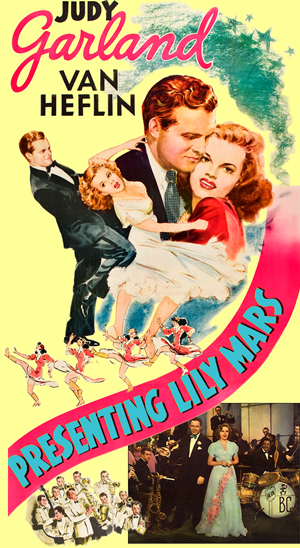
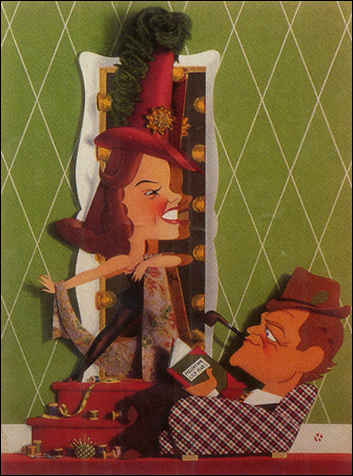
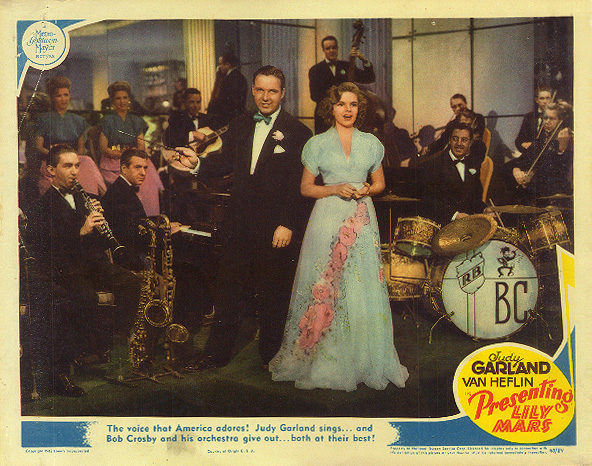
In November of 1942, 20-year-old
Judy Garland began pre-production work on Presenting
Lily Mars (1943), a slight "little film"
that, although not well known to the general public as
one of Judy Garland's big hits, is notable for several
reasons:
 1) Lily Mars was a major step in Judy's
successful transition to
adult roles from adolescent roles. 1) Lily Mars was a major step in Judy's
successful transition to
adult roles from adolescent roles.
2) Lily Mars was Judy's first teaming with producer
Joe Pasternak and with future director Charles Walters.
3) Lily Mars was the first time that MGM would
give Judy the "glamour
treatment."
4) It's a fun, infectious film!
Based on a novel by Booth Tarkington, Presenting Lily
Mars is the story of stage-struck small-town girl
Lily Mars. When Broadway producer (and local boy) John
Thornway (Van Heflin) comes to town to visit family and
also show off his current hit, Lily sees this as her big
chance to impress him with her talent. She doesn't succeed.
He thinks she's a pest. Lily then decides to follow him
to New York and sneaks into his theater during rehearsals
for his new show. John finally begins to see something
in Lily, and when the diva of his show, Isobel Rekay (played
by Marta Eggerth) becomes jealous and walks out, John turns
to Lily to quickly learn the show for the opening. In an
interesting twist from the normal "star walks out, unknown becomes
star" scenario, Isobel comes back just as John realizes
that this role is all wrong for Lily. Ever the trouper,
Lily agrees to taking back her two-line walk-on role, realizing
that her time as a star will come. The film ends with Lily's
big debut as the star of her own show.
Judy
began work on Presenting Lily Mars while finishing
the filming of For
Me And My Gal (1942) during
the fall of 1942. During that same time period she recorded and filmed her solo guest
spot in Thousands Cheer (1943) singing "The
Joint Is Really Jumpin' Down At Carnegie Hall." Lily
Mars had originally been slated as a drama to star
Lana Turner. However, "Smart Ol' Joe Pasternak"
(as Esther Williams would later call him) had just come
to MGM from producing a successful series of musicals at
Universal Studios starring Deanna Durbin (Judy's chief "rival"
during the early days at MGM), and he saw the story as
a chance to finally work with Judy. In fact, Presenting
Lily Mars is just the kind of film one would expect
Deanna Durbin to star in.
Pasternak loved working with Judy Garland. Back in 1937
Deanna Durbin shot to stardom with Three Smart Girls,
a Pasternak production originally meant for Judy as the
star. When MGM wouldn't loan Judy to Universal Studios,
Deanna got the part. Now, 6 years later, Pasternak got
his chance. Presenting Lily Mars would be the
beginning of a long career at MGM for Pasternak. His films
would only be rivaled by the super-musicals of "The Freed Unit",
also at MGM.  Both Pasternak and Freed would become the two
preeminent producers on the MGM Lot. So much so that years
later, contract dancer Dorothy Raye would remark, "..and
we just shuffled between the two." Pasternak came
to Judy's aid several years later, as she was having personal
and professional difficulties, and would help restore her
confidence, with In The Good Old Summertime (1949)
and Summer Stock (1950 - Judy's last MGM film). Both Pasternak and Freed would become the two
preeminent producers on the MGM Lot. So much so that years
later, contract dancer Dorothy Raye would remark, "..and
we just shuffled between the two." Pasternak came
to Judy's aid several years later, as she was having personal
and professional difficulties, and would help restore her
confidence, with In The Good Old Summertime (1949)
and Summer Stock (1950 - Judy's last MGM film).
Filming Lily Mars went
along without any problems. Judy was happy and healthy,
and at a perfect weight, having gained back some of the
weight lost during For
Me And My Gal. Filming was completed by November 3,
1942, when Judy had a sitting in the MGM portrait studio, having some of the loveliest photos ever taken of her.
The only issue anyone had once the film was finished was
the original finale, "Paging Mr. Greenback," was
a topical and appropriately patriotic song, with Judy performing
the number with chorus in front of the "U.S. Capitol
Building" backdrop first used for Babes In Arms. Everyone involved at the studio agreed that not only did
the number (as good as it was) fail to sufficiently show
the Lily Mars character as a new Broadway sensation, but
it was also below par for Judy. Judy was now becomming
MGM's biggest female musical star. She was on the fast
track to becoming one of the few child stars to successfully
make the transition to adult stardom. Those around Judy
pointed out that, in its present state, Lily Mars was
a little beneath what audiences had come to expect from
a Judy Garland musical. Judy went to L.B. Mayer, and he
brought in Pasternak and told him to shoot a new finale
in the MGM style. Pasternak enlisted the help of the burgeoning "Freed
Unit" (so named after producer Arthur Freed). Pasternak
felt that the new ending was too "big" for a
little musical such as this. But, he didn't want to let
Judy or the studio down and filmed the ending you see now.
On
February 20, 1943, while in the middle of production on Girl Crazy (1943)
Judy was in rehearsals for the new Lily Mars "big finale."
Musical arranger Roger Edens and crew devised a big 10
minute finale covering all forms of popular music. It would
be edited down to approximately 5 minutes for the final
release. Tommy Dorsey, at the studio filming Girl Crazy with
Mickey Rooney and Judy, was employed to accompany Judy in the "Broadway
Rhythm" finale to the finale. As was Charles Walters.
He had just come to the studio from Broadway as a dancer,
but the studio felt he would be better behind the scenes.
He danced with Judy here, and also in Girl Crazy.
He would become one of the studios top musical directors,
directing the Garland/Astaire mega-hit Easter Parade (1948).
 By March 16, 1943, Lily Mars was completed and
released the following month to glowing reviews. Judy had
really blossomed in Lily Mars. For the first time,
the studio presented her in the same glamorous way they
would for Lana Turner or Hedy Lamarr. As with For
Me And My Gal (1942) she had a leading man who was NOT
an adolescent. By March 16, 1943, Lily Mars was completed and
released the following month to glowing reviews. Judy had
really blossomed in Lily Mars. For the first time,
the studio presented her in the same glamorous way they
would for Lana Turner or Hedy Lamarr. As with For
Me And My Gal (1942) she had a leading man who was NOT
an adolescent.
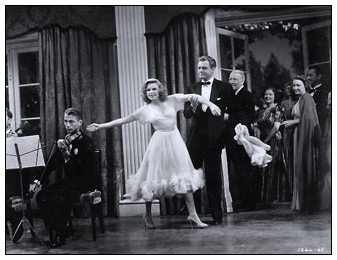
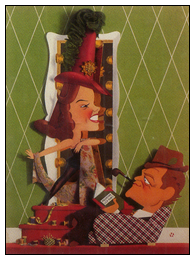
The new finale really showcased the new "adult"
Garland, with her hair up and wearing a glamorous dress
(see picture above, left). Judy was at the crest of a "Golden
Period" for her at MGM both professionally and personally.
A period which would reach its peak with Meet Me In
St. Louis (1944), The Clock (1945), and The
Harvey Girls (1946) and culminate with the birth of
her first child in 1947, Liza Minnelli.
In Lily Mars,
Judy is more than just beautiful, she gives one of her
best light comedic performances. Judy is known primarily
as a singer/actress but what most people don't realize
is that she was an exceptional comedienne. MGM would notice
this too. Chronologically, each film she made had more
and more comedy elements added. Judy was a master at "self-deprecating humor" -
as evidenced in films such as In The Good Old Summertime (1949)
and The Pirate (1948). She was this way in her
personal life as well, always being able to see the absurdity
and humor of most situations - and being able to make everyone
laugh.
Lily Mars is vintage MGM: A nice story with talented
stars (Van Heflin would win a Best Supporting Actor Oscar
in 1943 for his performance in the 1942 film Johnny
Eager), talented and dependable supporting players
(Annabelle Logan who played Lily Mars' sister Rosie, would
go on to be the popular jazz singer Annie Ross), and expert
MGM production values all coming together to make an enduring
film for all ages to enjoy. "They Don't Make 'Em Like
They Used To" - but don't you think they should??
|
top of page


|
|
|
Click
on any of the pics above
to to see the gallery of photos and media. |
|
top of page


The complete soundtrack is now available for download!
TRACK
LISTING
Tracks featuring Judy Garland noted with blue text.
* Stereo
** Partial Stereo
Title |
Performed
by... |
Time |
Part One - Ziegfeld Girl |
| Overture |
MGM Studio Orchestra |
2:08 |
| Laugh? I Thought I'd Split My Sides |
Judy Garland & Charles Winninger |
1:58 |
| You Stepped Out Of A Dream ** |
Tony Martin & The MGM Studio Chorus |
6:32 |
| Whispering |
Bill Days, John Rarig & Max Smith |
1:09 |
| I'm Always Chasing Rainbows (Rehearsal) |
Judy Garland & Charles Winninger |
1:27 |
| I'm Always Chasing Rainbows (Audition) |
Judy Garland |
0:50 |
| I'm Always Chasing Rainbows (Ballad) |
Judy Garland |
2:12 |
| Caribbean Love Song |
Tony Martin, dance by Antonio & Rosario |
7:35 |
| Minnie From Trinidad |
Judy Garland & The MGM Studio Chorus |
5:25 |
| Mr. Gallagher & Mr. Shean |
Charles Winninger & Al Shean |
2:30 |
| Finale |
Judy Garland, Tony Martin & The MGM Studio Chorus |
6:55 |
| Original Finale (Part 1) |
Judy Garland, Tony Martin & The MGM Studio Chorus |
3:54 |
| Too Beautiful To Last (Demo Recording) |
Tony Martin, with Roger Edens at piano |
1:37 |
Pre-Recording Sessions |
| You Stepped Out Of A Dream (False Starts) |
Tony Martin |
2:58 |
| You Stepped Out Of A Dream (Alternate Stereo) * |
Tony Martin & The MGM Studio Chorus |
6:37 |
| I'm Always Chasing Rainbows (Audition Take 3) |
Judy Garland |
0:55 |
| I'm Always Chasing Rainbows (Audition Take 4) |
Judy Garland |
0:53 |
| I'm Always Chasing Rainbows (Ballad Take 4) |
Judy Garland |
0:36 |
| I'm Always Chasing Rainbows (Ballad Take 5) |
Judy Garland |
1:05 |
| I'm Always Chasing Rainbows (Ballad Take 6) |
Judy Garland |
2:29 |
| I'm Always Chasing Rainbows (Ballad Take 7) |
Judy Garland |
2:30 |
| Minnie From Trinidad (Alternate Take Stereo) * |
Judy Garland & The MGM Studio Chorus |
5:01 |
| Deleted Finale Reprise |
Judy Garland, Tony Martin & The MGM Studio Chorus |
1:15 |
| Deleted Finale Reprise (Takes 1 & 2) |
Judy Garland, Tony Martin & The MGM Studio Chorus |
1:18 |
| Deleted Finale Reprise (Takes 3) |
Judy Garland, Tony Martin & The MGM Studio Chorus |
1:35 |
| Deleted Finale Reprise (Take 4) |
Judy Garland, Tony Martin & The MGM Studio Chorus |
1:47 |
| Deleted Finale Reprise (Takes 5 & 6) |
Judy Garland, Tony Martin & The MGM Studio Chorus |
2:20 |
Extras |
| Minnie From Trinidad (Remastered Film Version) |
Judy Garland & The MGM Studio Chorus |
5:42 |
| Leo Is On The Air (MGM Radio Promo Record) |
Judy Garland, Tony Martin, Roger Edens |
14:15 |
Part Two - Presenting Lily Mars |
| Overture |
The MGM Studio Orchestra |
1:32 |
| Lady Macbeth |
Judy Garland, Annabelle Logan, Van Heflin |
2:24 |
| The Gypsy In Me |
Marta Eggerth |
3:29 |
| Tom, Tom The Piper's Son |
Judy Garland |
2:42 |
| Love Is In The Air |
Judy Garland & The MGM Studio Chorus |
1:29 |
| Ev'ry Little Movement Has A Meaning Of Its Own * |
Judy Garland & Mary Kent (for Connie Gilchrist) |
2:12 |
| When I Look At You |
Marta Eggerth |
2:35 |
| When You Think Of Lovin' |
Bob Crosby & His Orchestra, The Wilde Twins |
1:22 |
| When I Look At You * |
Judy Garland |
1:34 |
| When I Look At You (Comedy Version aka Caro Mono) * |
Judy Garland |
3:06 |
| A Russian Rhapsody |
Judy Garland |
0:23 |
| A Russian Rhapsody |
Marta Eggerth & The MGM Studio Chorus |
4:18 |
| Finale (Film Version) * |
Judy Garland, Charles Walters, Tommy Dorsey & His Orchestra, The MGM Studio Chorus |
6:28 |
| Pagin Mr. Greenback (Outtake) * |
Judy Garland & The MGM Studio Chorus |
4:53 |
Pre-Recording Sessions |
| When I Look At You (Take 10) * |
Judy Garland |
1:49 |
| When I Look At You (Tag - Take 9) * |
Judy Garland |
0:36 |
| When I Look At You (Tag - Take 10) * |
Judy Garland |
0:26 |
| Ev'ry Little Movement Has A Meaning Of Its Own * |
Judy Garland & Mary Kent (for Connie Gilchrist) |
2:50 |
| Finale Part 1 * |
Judy Garland & The MGM Studio Chorus |
4:02 |
| Finale Part 2 * |
Judy Garland & The MGM Studio Chorus |
1:32 |
| Finale Part 3 * |
Judy Garland & The MGM Studio Chorus |
1:14 |
| Finale Part 4 * |
Judy Garland & The MGM Studio Chorus |
1:52 |
| Finale Part 5 * |
Judy Garland & The MGM Studio Chorus |
1:50 |
| Finale Part 6 * |
Judy Garland, Charles Walters, Tommy Dorsey & His Orchestra, The MGM Studio Chorus |
3:01 |
| Finale Part 6 (Pick-up) * |
Judy Garland & The MGM Studio Chorus |
0:55 |
| Finale (Complete Version) * |
Judy Garland, Charles Walters, Tommy Dorsey & His Orchestra, The MGM Studio Chorus |
9:16 |
|

DATE |
EVENT |
Mid June 1942 |
Preproduction work begins on Presenting
Lily Mars |
06/25/42 |
Judy is still working on For
Me And My Gal, and records the following "Finale" retakes
(at the MGM Recording Studio) of "When
Johnny comes Marching Home Again"
and "For Me And My Gal" |
Mid to late July 1942 |
Preproduction work (including wardrobe,
hair & makeup tests, and dance rehearsals) continue
for Lily Mars |
07/28/42 |
Judy records "Tom, Tom, The
Piper's Son" and "Every Little Movement" |
07/29/42 |
|
Aug - Sep 1942 |
Lily Mars is in production |
09/18/42 |
Judy records "When I Look At
You"
(both the ballad and comedy versions) |
10/16/42 |
Judy & chorus records "Paging Mr. Greenback" |
Early Nov 1942 |
Production is completed for Lily Mars |
11/03/42 |
|
November 1942 - February 1943 |
|
02/20/42 - 03/03/43 |
Judy is in rehearsals for the new
finale for Presenting Lily Mars |
03/04/43 |
Judy records "Broadway Rhythm"
for the Lily Mars new finale. At the MGM Recording Studio. |
03/05/43 |
Judy & Chorus record "Where There's
Music" |
03/06/43 - 03/16/43 |
Judy is filming the new Lily
Mars finale ("Where There's Music") |
03/16/43 |
Final shooting day for Lily
Mars |
04/02/43 |
Presenting Lily Mars is released |
top of page
WHAT THE CRITICS SAID:
"Metro-Goldwyn-Mayer, which dotes on young Judy Garland,
is again having her show off her best points ... Miss Garland
is fresh and pretty, she has a perky friendliness that is
completely disarming, and she sings and dances according
to the mood - sometimes raucous jive, sometimes sweet little
ballads that turn out to be quite enchanting. No doubt about
it, Miss Garland is a gifted young lady."
- The New York Times, April 30, 1943
Presenting Lily Mars is a conventional screen version of
73-year-old Booth Tarkington's tale of a stage-struck small-town
girl. This juvenile darling (Judy Garland) gets to Broadway
before you can say Jake Shubert, marries a great producer
(Van Heflin) and is soon seen swaying in black tulle in
a super-sumptuous musical show staged by the lucky fellow.
- Time Magazine
Songs are about equally divided between Judy Garland and
Marta Eggerth, with both putting over respective numbers
in scintillating fashion.
- Variety, April 27, 1943
Judy grows better and better, and this picture registers
a new high in performance and charm. She exhibits a dancing
talent that is delightful in its grace and poise.
- The Motion Picture Herald
|
top of page

PRODUCTION
STAFF:
Production No. 1264
Produced by: Joseph Pasternak
Directed by: Norman Taurog
Screenplay by: Richard Connell and Gladys Lehman
(based on the novel by Booth Tarkington)
Songs by: Walter Jurmann, Paul Francis Webster,
E.Y. Harburg, Burton Lane, and Roger Edens
Musical adaptation: Roger Edens
 Music direction: Georgie Stoll Music direction: Georgie Stoll
Dance direction: Ernst Matray
Photography: Joseph Ruttenberg
Editor: Albert Akst
Art direction: Cedric Gibbons
Filmed: September 1942 - March 1943
Released: April 2, 1943
CAST:
Judy Garland ... Lily Mars
Van Heflin ... John ("Thorny") Thornway
Fay Bainter ... Mrs. Thornway
Richard Carlson ... Owen Vail
Spring Byington ... Mrs. Mars
Marta Eggerth ... Isobel Rekay
Connie Gilchrist ... Frankie
Leonid Kinskey ... Leo
Patricia Barker ... Poppy
Janet Chapman ... Violet
Annabelle Logan ... Rosie
Douglas Croft ... Davey
Ray McDonald ... Charlie Potter
Tommy Dorsey and His Orchestra ... Themselves
Bob Crosby and His Orchestra ... Themselves
The Wilde Twins ... Themselves
Charles Walters ... Specialty Dancer (Judy's dance
partner in finale)
Joe Yule (Mickey Rooney's real life father) ...
Mike, the stage doorman
A special note of thanks
to MIchael Siewert and the late Eric Hemphill for providing many rare items for these pages. Thanks
guys!!!
top of page
© The Judy Room
|
|