March 31, 1943: "Oklahoma!"
opens on Broadway to instant success and acclaim. This did not go unnoticed
by MGM Musical producer Arthur Freed. Freed's musical assistant Roger
Edens had seen "Oklahoma!" before it opened. He advised Freed
that a film musical with the same rustic elements would also be a big
hit. A year before, MGM had bought the 1942 novel by Samuel Hopkins
Adams "The Harvey Girls" as a vehicle for Lana Turner. Knowing
it would be years before "Oklahoma!" would be available for
the screen, Freed seized the opportunity to take "The Harvey Girls"
and make it into a showcase for Judy Garland.
And showcase it was! Six screenwriters worked on
the script; several noted character actors were given good supporting
roles; a solid director: George Sidney (who just so happened to have
directed Judy Garland's screen test for MGM 10 years before); and
above all, a new fully integrated score was written by Harry Warren
and Johnny Mercer. The film would go on to become a huge hit - chiefly
due to its star: Judy Garland. Judy was at the pinnacle of her career
at MGM. The year before production began on The Harvey Girls,
Judy had scored a double hit with audiences and critics with the masterpiece
Meet Me In St. Louis
and her first dramatic film The Clock. She followed these with
the filming of her wickedly satirical "Madame Crematon"
for Ziegfeld Follies (also not released until 1946). Judy Garland
had pulled off a feat rare in Hollywood: The transition from "Child
Star" to that of a desirable "adult" leading lady.
Judy Garland was, simply, a "Superstar" and the reigning
queen of the MGM Lot.
 The
Harvey Girls proved (as if there were any doubt) that Judy Garland
could handle anything. This time out, she had great songs, costumes,
co-stars, a love interest, and comedy. The public ate it up! It was
so profitable that it would be listed on Variety's list of "All
Time Box Office Champions" for the next 40+ years. And of course,
the song "On The Atchison, Topeka, And The Santa Fe" would
win the Oscar as the best song of the year. The
Harvey Girls proved (as if there were any doubt) that Judy Garland
could handle anything. This time out, she had great songs, costumes,
co-stars, a love interest, and comedy. The public ate it up! It was
so profitable that it would be listed on Variety's list of "All
Time Box Office Champions" for the next 40+ years. And of course,
the song "On The Atchison, Topeka, And The Santa Fe" would
win the Oscar as the best song of the year.
The story is about a young woman who travels West
on the Atchison, Topeka and The Santa Fe Railroad to Sandrock, NM
as a "mail order bride." The novel was based on the real
life existence of the Fred Harvey Company and its chain of hotel/restaurants
all along the railroad in the late 19th and early 20th Centuries.
These "Harvey Hotels" were always on the edge of civilization,
and in many cases instrumental in the settling of the area. Harvey
Hotels still exist today.
In our story, Susan Bradley (Judy) is on her way
to Sandrock on the same train as a staff of Harvey Girls on their
way to open a new hotel/restaurant. Upon arrival, Susan discovers
her "finance" to be the butt of a practical joke played
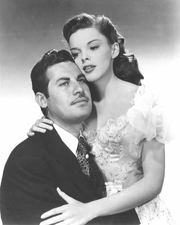
by a local big shot saloon owner Ned Trent (John Hodiak). Susan joins
forces with the Harvey Girls, and the ensuing dramatics center around
the struggle between good (the Harvey Girls) and bad (the Saloon Girls)
- and the romance between Susan and Ned. In between there is time
for comic relief provided by Ray Bolger and Virginia O'Brien, as well
as songs, dances, and even a "girl fight." It's all great
fun. Light, enjoyable entertainment with the polish and expertise
that only the Freed Unit at MGM in their heyday could accomplish.
Everyone involved was at the peak of their talents.
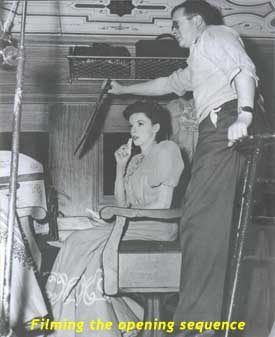
The Harvey Girls is a unique film in the
Arthur Freed roster of hits. Like Meet
Me In St. Louis, it's an original written directly for the
screen with new songs written expressly to advance the plot or explain
character motivation. But unlike most of the other films, it has a
western background - and is a showcase for one star billed above the
title. Beginning in the late 1940's, the Freed Unit would shift to
films that either had their origins on Broadway, or were based on
an existing catalog of songs from various famous composers and lyricists,
albeit usually with an original story line - with an emphasis on dance
to further the plot. The Harvey Girls is more character driven,
with an emphasis on fun, This is the reason it survives today as a
perennial favorite - due to all of its singular and special charms.
Top
of page
ABOUT
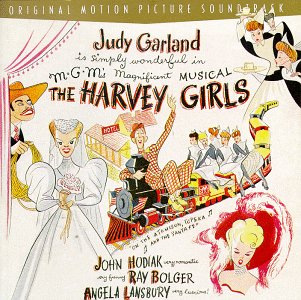
THE DISC & RECORDINGS:
 From
the PRODUCERS NOTES in the CD Booklet: From
the PRODUCERS NOTES in the CD Booklet:
"It is with great pleasure that we premiere the original
soundtrack album to one of the best MGM Musicals of all time,
The Harvey Girls, featuring the timeless songs of Harry
Warren and Johnny Mercer, perfectly rendered by the extraordinary
Judy Garland and a stellar supporting cast.
The music for The Harvey Girls was
recorded with several microphones placed strategically throughout
the scoring stage, each creating discrete recordings called
"angles" that captured the vocals and different
sections of the orchestra. Each angle was then edited, using
portions of many different 'takes' of each song or score piece.
Finally, the edited vocal orchestral angles were mixed to
monaural composite tracks ('comps') in preparation for final
use in the film.
While very few angles for The Harvey
Girls were available, most of the orchestral and vocal
comps did survive the aging process and were used to master
most selections on this album. Individual angles were available
for the Oscar-winning 'On The Atchison, Topeka, And The Santa
Fe,' the joyous 'Swing Your Partner Round And Round,' and
the wonderful outtake 'March Of The Doagies,' enabling us
to mix these selections in true stereo. Neither comps nor
angles were available for a portion of 'Training Montage (The
Train Must Be Fed)' or 'Wait And See' reprise #2, so it was
necessary to replace missing sections with the music and effects
track of the fine-grain print master. Due to the natural aging
process of all production elements, the listener will note
occasional variations in fidelity. Selections are presented
in their original order and by name as they appear in the
conductor's score."
Top
of page
|
TRACK
LISTING
Music conducted by ..Lennie
Hayton
Music and Lyrics by ..Harry
Warren & Johnny Mercer
Additional Music and Lyrics by ..Kay
Thompson, Ralph Blane, Conrad Salinger
Additional Arrangements and Orchestrations by ..Conrad
Salinger, Bob Franklyn, Ted Duncan, David Raksin, Roger Edens,
Wally Heglin, Daniele Amphitheatrof, Paul Marquardt, Joseph
Nussbaum
Vocal Arrangements by:..Kay
Thompson
All music recorded in Culver City, California
Recordings in stereo noted by an asterisk
* ...................... JUDY
GARLAND tracks in BLUE
|
TITLE |
PERFORMED BY |
RECORDING DATE |
TIME |
| Main Title |
MGM Studio
Orchestra |
6.30.1945 |
2:28 |
| In
The Valley (Where The Evening Sun Goes Down) |
Judy Garland |
02.16.1945 |
2:25 |
| Wait And
See |
Virginia
Reece (for Angela Lansbury), with Roger Edens at the Piano |
02.15.1945 |
1:48 |
| On
The Atchison, Topeka, And The Santa Fe* |
Judy Garland,
Cyd Charisse, Virginia O'Brien, Marjorie Main, Ray Bolger,
[click here for continuation]
|
01.05.1945,
01.06.1945, 01.08.1945, 04.08.1945, and 06.30.1945 |
8:37 |
| Training
Montage (The Train Must Be Fed) |
Edward
Earle, Selena Royle, Marjorie Main, Joe Karnes, Elva Kellogg,
Judy Garland, Virginia O'Brien, Cyd Charisse, and the
MGM Studio Chorus |
01.13.1945
and 06.30.1945 |
1:52 |
| Oh, You
Kid (extended version) |
Virginia
Reece (for Angela Lansbury) |
02.15.1945 |
3:10 |
| Judy Gets
The Meat |
MGM Studio
Orchestra |
06.30.1945 |
1:05 |
| Honky Tonk |
MGM Studio
Orchestra |
06.30.1945 |
:54 |
| Wait And
See reprise #1 (extended version) |
Kenny
Baker, with Lud Donkowski/Luther Rountree/Frank Saputo
on guitar |
02.16.1945 |
1:48 |
| It's
A Great Big World |
Judy Garland,
Virginia O'Brien, and Marion Doenges (for Cyd Charisse) |
01.05.1945** |
6:19 |
| The Wild,
Wild West |
Virginia
O'Brien |
01.29.1945,
06.30.1945, and 08.03.1945 |
3:08 |
| Judy Goes
To The Valley |
MGM Studio
Orchestra |
06.30.1945 |
:40 |
| My
Intuition (outtake) |
Judy Garland
and John Hodiak |
02.16.1945
& 06.30.1945 |
3:27 |
| Wait And
See reprise #2 |
Kenny
Baker and Marion Doenges (for Cyd Charisse) |
02.16.1945
and 08.03.1945 |
4:05 |
| Judy's Fight |
MGM Studio
Orchestra |
06.30.1945 |
1:49 |
| Ray Bolger
Dance (On The Atchison, Topeka, And The Santa Fe) |
MGM Studio
Orchestra |
02.15.1945
and 06.30.1945 |
3:11 |
| Swing
Your Partner Round And Round* |
Judy Garland,
Marjorie Main and the MGM Studio Chorus |
02.19.1945
and 06.30.1945 |
5:55 |
| March
Of The Doagies (outtake)* |
Judy Garland,
Joe Karnes, Frank Laine, Don Ellis, Eugene Dorian, Ralph
Blane, Don Williams, and the MGM Studio Chorus |
02.17.1945 |
2:48 |
| In
The Valley (Where The Evening Sun Goes Down) reprise
(outtake)* |
Kenny
Baker, Judy Garland, and the MGM Studio Chorus |
02.17.1945 |
2:55 |
| The Fire/Morning
After |
MGM Studio
Orchestra |
08.03.1945 |
3:05 |
| Coda/New
End Title |
MGM Studio
Orchestra and Chorus |
06.30.1945
and 08.03.1945 |
2:34 |
| SUPPLEMENTAL
MATERIAL |
| In
The Valley (Where The Evening Sun Goes Down) (vocal/piano
demo) |
Judy Garland
and Kay Thompson with Roger Edens at the piano |
04.23.1945 |
1:29 |
| March
Of The Doagies (reprise/outtake) |
Judy Garland
and the MGM Studio Chorus |
02.17.1945 |
1:07 |
| Hayride
(outtake) |
Ray Bolger,
Judy Garland, and the MGM Studio Chorus |
02.19.1945 |
5:14 |
| End Title
(alternate version) |
MGM
Studio Orchestra and Chorus |
06.30.1945 |
1:35 |
Continuation
of the participants in the recording of "On The Atchison,
Topeka, And The Santa Fe": Benny Carter, The Seckler
Group, The Williams Brothers (Andy, Bob, and Don), Alice Ludes,
Dorothy McCarthy, Lee Botch, Jud Conlon, Ralph Blane, Loulie
Jean Norman, Dorothy Jackson, Judy Matson, Mary Moder, Ruth
Clark, Jimmie Garland, Dorothy Wilkerson, Vivian Edwards,
Joe Karnes, Kenneth Rundquist, Claude Martin, Arnet Amos,
Elva Kellogg, and the MGM Studio Chorus
** "Introduction
to Great Big World" Performed by the MGM Studio Orchestra,
recorded on 06.30.1945
Top
of page
|
NOTES
 The
Harvey Girls was completed on June 4, 1945 but did not
premiere until January 1946 due to the amount of product that
MGM had on the market and/or slated ahead of the film. The
Harvey Girls was completed on June 4, 1945 but did not
premiere until January 1946 due to the amount of product that
MGM had on the market and/or slated ahead of the film.
Judy Garland would marry Vincente Minnelli
just eleven days after principle photography was completed
for The Harvey Girls.
This was Judy's last starring role in a
musical until after the birth of daughter Liza Minnelli in
1946 (Judy would film her guest spots in Till The Clouds
Roll By in 1945 and would not return until 1947 to film
The Pirate).
"On The Atchison, Topeka, And The
Santa Fe" on the Oscar for Best Song of 1946. Strangely,
Judy rarely ever sang it after leaving MGM.
Director George Sidney has since marvelled
at the genius of Judy Garland. Judy had a reputation for being
one of the quickest learners in all of Hollywood. She could
hear a song once or twice, then sing it back as if she had
been practicing for days. Same with dancing, both Gene Kelly
and Fred Astaire recalled how she was the quickest study they
had ever worrked with. On this occasion, Sidney been rehearsing
the staging of "On The Atchison, Topeka, And The Santa
Fe" for most of the day (on Lot 3 of the MGM Studios).
Judy came on the set, watched a "dance-in" go through
the number a couple of times, then said "I'm ready"
and did the number in one take. "...she did it like she
had been rehearsing it for six months. It was sheer genius!"
said Sidney. If you watch, her entrance through her part of
the song is one shot without any cuts.
The recording listed above of the Judy Garland/Kay
Thompson duet of "In The Valley (When The Evening Sun
Goes Down)" is the only known recording of these two
lifelong friends singing together. Kay Thompson's immense
talents and unique vocal style would have an influence on
Judy throughout her life. Kay would open up doors of musicality
for Judy that she didn't know existed. In fact, Judy would
be closer to Kay than she ever was or would be with another
woman. They were the best of friends. Kay would leave the
Freed Unit just a few years later, to form her own famous
nightclub act. Kay is also the author of the "Eloise"
books, and is the Godmother of Liza Minnelli.
Ray Bolger, of course, co-starred with Judy
six years earlier as The Scarecrow in The Wizard Of Oz.
They were lifelong friends and obviously got along wonderfully
- as evidenced when watching him as her guest on her T.V.
Series almost 20 years later. Ray's dance to "On The
Atchison, Topeka, And The Santa Fe" is, in my opinion,
one of the most underrated dances ever put on film.
Angela Lansbury was fresh off her success
in Gaslight (and Oscar nomination for Supporting
Actress) when she was cast in The Harvey Girls. She
later remarked about how much she learned from watching Judy
work - and would joke about how she received "hate mail"
after the film came out, from fans who chided her for being
so "mean to Judy"!!!
Cyd Charisse was just beginning to make
waves when she made The Harvey Girls. It would be another
6 years before she would achive a much deserved "real"
star status. Ms. Charisse is one of the most beautiful, elegant
dancers ever to appear on screen. She married Tony Martin
in the 1950's and they're still married today.
Virginia O'Brien was a popular "novelty"
singer/actress of the 1940's - famous for her "deadpan"
straight faced, no-nonsense delivery of songs. The legend
is that when she auditioned on Broadway, she was so nervous
she couldn't smile. The director liked her and hired her to
perform just as she did in the audition. This eventually worked
against her, and she was never taken seriously as a singer
or actress - and she was sadly under-utiilized by MGM. For
the latter part of shooting The Harvey Girls, she was
pregnant. So her scenes had to be shot quickly - this is why
you don't see her in the latter part of the film.
The surviving original pre-recording sessions
can be heard on the alternate audio tracks of the laser
disc Judy Garland The Golden Years At MGM. (INTERESTING
NOTE: On the laser disc, several numbers are in stereo that
are NOT in stereo on this disc).
NOTE: The
version of the song "On The Atchison, Topeka, And The
Santa Fe" as heard on this release, is slightly different
than in some subsequent Rhino compilations as well in the
actual film. In several of these compilations, including
the stellar Judy
Garland In Hollywood: Her Greatest Movie Hits the
ending of the song has been remixed.
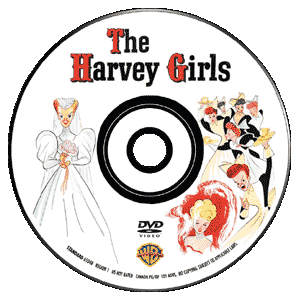
Also
available on DVD with all the pre-recording sessions on
the alternate tracks:
Top
of page
|

A look at the inside of the case.
Top
of page
DISC
CREDITS
Produced by Marilee Bradford, Bradley
Flangan, and John Fricke
Art Direction by Coco Shinomiya
and Tornado Design
Design by Tornato Design
Mixing, Editing, Audio Restoration,
and CD Mastering Services by Doug Schwartz, Audio Mechanics,
Los Angeles, CA
Additional Mixing Services by Ted
Hall, Pacific Ocean Post, Santa Monica, CA
Transfer Services by Chace Productions,
Burbank, CA
Photographs and Artwork courtesy of
John Fricke and Turner Entertainment Co.
Production Assistance by Woolsey
Ackerman, Bruce Baggot, Tom Eckmier, Norma "Big Red"
Edwards, Nancy "Lightnin'" Hopkins, and Dena Pacitti
Special Thanks to Scott Benson,
Patty Fricke, Jack Hansen, Gina Henschen, Craig Kamins,
Roger Mayer, Dorothy Tuttle Nitch, Brent Phillips, Dorothy
Gilmore Raye, John Schaefer, Charles Shultz, Rick Skye,
and Mary Beth Verhunce
Liner notes by John Fricke (NOTE:
Once again, the liner notes to this disc are some of the
best ever written)
A Very Special Thanks to George
Feltenstein and Allan Fisch for their archival assistance
Top
of page
|
Metro-Goldwyn-Mayer
PRESENTS
Judy Garland
IN
THE HARVEY GIRLS
WITH
JOHN HODIAK - RAY BOLGER - ANGELA LANSBURY
and Preston Foster - Virginia O'Brien - Kenny Baker - Marjorie Main - Chill Wills
ASSOCIATE PRODUCER: Roger Edens
SCREENPLAY BY Edmond Beloin, Nathaniel Curtis, Harry
Crane, James O'Hanlon, and Samson Raphaelson
ADDITIONAL DIALOG BY Kay Van Riper
WORDS AND MUSIC BY Johnny Mercer and Harry Warren
PRODUCED BY Arthur Freed - DIRECTED BY George
Sidney
Production No. 1348
Prodution dates: January 12, 1945 - June 4, 1945
 Film
was previewed on July 12, 1945 in Inglewood, California, USA Film
was previewed on July 12, 1945 in Inglewood, California, USA
Initial release date: January 18, 1946 Capitol
Theater, New York City, New York, USA
Running time: 101 minutes
Cost: $2,524,315.06
To give an idea of some of the costs involved in the film:
Total Cast Payroll: $443,7666.67
Writer's Payroll: $132,962.00
Costumes: $75,942.3
Construction and decoration (on the MGM Backlot) of the "Sandrock
Street" (exterior and interior of both the Harvey House and the
Alhambra Saloon): $395,969.40
Cost of extras for the Harvey House burning scene: $7,440.00
Initial domestic gross: $5,175,000.00+
Produced by Arthur Freed
Associate Producer Roger Edens
Directed by George Sidney
Screenplay by Edmund Beloin, Nathaniel Curtis, Harry Crane,
James O'Hanlon, Samson Raphaelson
(based on a story by Samuel Hopkins Adams, based on an original story
by Eleanore Griffin and William Rankin,
with additional dialogue by Kay Van Riper, Guy Bolton, Hagar Wilde)
Technicolor Consultants: Natalie Kalmus, Henri Jaffa
Art Direction by Cedric Gibbons, William Ferrari
Set Decorators: Edwin B. Willis, Mildred Griffiths
Costume Supervisor: Irene
Costumes by Helen Rose
Men's Costumes by Valles
Makeup by Jack Dawn
Music and Lyrics by Johnny Mercer and Harry Warren
Musical Direction Lennie Hayton
Orchestrations by Conrad Salinger
Musical Arrangements by Kay Thompson
Musical Numbers Staged by Robert Alton
Sound: Douglas Shearer
Special Effects by Warren Newcombe
Photography by George Folsey
Editor Albert Akst
CAST:
Judy Garland ... Susan Bradley
John Hodiak ... Ned Trent
Ray Bolger ... Chris Maule
Preston Foster ... Judge Sam Purvis
Virginia O'Brien ... Alma
Angela Lansbury ... Em
Marjorie Main ... Sonora Cassidy
Chill Wills ... H.H. Hartsey
Kenny Baker ... Terry O'Halloran
Selena Royle ... Miss Bliss
Cyd Charisse ... Deborah
Ruth Brady ... Ethel
Catherine McLeod ... Louise
Jack Lambert ... Marty Peters
Edward Earle ... Jed Adams
Virginia Hunter ... Jane
William "Bill" Phillips, Norman Leavitt ... Cowboys
Ray Teal ... Conductor
Horace (Stephen) McNally ... Golddust McClean
Jack Clifford ... Fireman
Vernon Dent ... Engineer
Paul "Tiny" Newlan ... Station Agent
Jim Toney ... Mule Skinner
Morris Ankrum ... Reverend Claggett
Lucille Casey, Mary Jo Ellis, Dorothy Gilmore,
Gloria Hope, Mary Jean French,
Daphne Moore, Joan Thorson, Dorothy Tuttle ... Harvey Girls
Hazel Brooks, Kay English, Hane Hall, Vera Lee,
Peggy Maley, Erin O'Kelly, Dorothy Van Nuys,
Eve Whitney, Dallas Worth ... Dance Hall Girls
Ben Carter ... John Henry
Byron Harvey Jr, Beverly Tyler ... Bits
Top
of page
|