IN
TRIBUTE TO THE LATE RONALD HAVER
The man most responsible for rescuing and preserving the most
complete version of A Star Is Born possible.
|
The
following is his article
"A STAR IS BORN AGAIN"
as published in American Film Magazine's July-August
1983 issue.
Ron
Haver
|
 |
This is a preview of his incredible book - A Star
Is Born - The Making of the 1954 Film and its 1983 Restoration

A STAR IS BORN AGAIN
The
search for the missing half hour from George Cukor’s
classic had all the ingredients of a detective story.
Ronald Haver
 |
On
July 7 in New York, the Academy of Motion Picture Arts
and Sciences, in association with Warner Bros., is presenting
a most unusual event: the premiere of a restored version
of the 1954 classic A Star Is Born, with Judy
Garland and James Mason. Following the opening, the
new-old film will travel to Chicago, San Francisco,
Los Angeles, and Dallas in a series of single-evening
screenings.
The recovery of this lost classic is a saga in itself,
one marked not only by the passion and diligence of
the researchers, but by the spirit of cooperation among
the various institutions – studios, archives,
trade associations, and agencies, involved in the restoration.
This is a personal account of the effort to restore A Star Is Born to the original three-hour
film that its director loved so much he could never
bear to see the cut version. – Eds.
|
George
Cukor’s 1954 version of A Star Is Born is
legendary for the way it was edited against its director’s
wishes. About a half hour was taken out of the film, and
over the years, among Cukor aficionados, the search for the
missing material took on aspects of the quest for the Holy
Grail.
I know, because I’m one of them. I was fifteen when I
first saw A Star Is Born. The ads proclaimed it “the
most eagerly awaited motion picture of our time.” It was
Jack Warner’s all-or-nothing gamble on the comeback of
Judy Garland. She hadn’t made a movie in four years. After
a decade and a half on the MGM roster, she had been fired for
“unreliability,” had a nervous breakdown, attempted
suicide, and divorced her director-husband Vincente Minnelli.
Her third husband, a promoter named Sid Luft, masterminded
her triumphant return to show business.
In
early 1953 she and Luft made a deal with Warner Bros.; the
company agreed to finance a remake of David O. Selznick’s A
Star Is Born (1937). Luft would produce, George Cukor
would direct from a new script by Moss Hart, and Harold Arlen
and Ira Gershwin would compose the songs. With James Mason
as the alcoholic movie superstar Norman Main, who transforms
band singer Esther Blodgett (Garland) into star Vicki Lester,
filming got under way; the budget was $2 million. Technical
delays –
caused
by the new CinemaScope process – Garland’s emotional
ups and downs, and Cukor’s perfectionism stretched the
shooting schedule from three months to nearly seven, and the
budget ballooned to an astronomical (for 1954) $5 million.
The picture was given the largest, gaudiest, most spectacular
opening Hollywood had seen in years. On September 29, 1954,
dozens of spotlights formed a huge star over the Pantages Theatre
on Hollywood Boulevard, and more than twenty thousand fans jammed
the area around Hollywood and Vine.For the first time, television
cameras covered a Hollywood opening live from coast to coast.
Life called it “a brilliantly staged, scored,
and photographed film, worth all the effort” and the New
York Times said it was “stunning.”  Several
weeks later, though, Variety carried a short item noting
that Warners would trim A Star Is Born from three hours
to two and a half. Although business had been good, theater
owners had complained that the long running time would keep
the number of showings down to three per day instead of four
or five, thus cutting into revenue. Several
weeks later, though, Variety carried a short item noting
that Warners would trim A Star Is Born from three hours
to two and a half. Although business had been good, theater
owners had complained that the long running time would keep
the number of showings down to three per day instead of four
or five, thus cutting into revenue.
In the film Norman Maine tries to explain to Esther Blodgett
what greatness is: “There are certain pleasures you get
– little jabs of pleasure when a swordfish takes the hook…or
watching a great dancer – you don’t have to know
about ballet. That little bell rings inside – that little
jolt of pleasure. That’s what happened to me just now.”
So it was with me and A Star Is Born one hot Sunday
afternoon. I was disappointed at seeing the shortened version
because I wanted more of those “little jabs of pleasure.”
I wanted more of the art direction – so carefully and
tastefully understated – and of the subtle richness of
the photography that filled the huge CinemaScope screen with
compositions I’d never seen in a film. I wanted to see
and hear the two missing musical numbers. I wanted more of the
Moss Hard and Cukor’s observations of the Hollywood social
scene, the studio atmosphere, and the ambience of Los Angeles
and its environs, more of the elegance and wry sense of humor
that permeated the film. But Warners had withdrawn the three-hour
version, and it never reappeared.
In 1971, when I was a projectionist in Los Angeles at The American
Film Institute, I had the chance to see all of George Cukor’s
films. Cukor and Gavin Lambert were screening them during research
on Lambert’s book On Cukor. I was completely in awe of
Cukor, who was as witty, as elegant, and as forthright as his
work. I asked him if we could screen his personal print of A
Star Is Born. “I don’t have a copy,”
he said. “I don’t have any of my films. All I have
are scripts and stills.” I implored the AFI’s film
librarian to try to get the 181-minute version from Warners.
Back came the word: All the studio had was a stereo print that
ran 154 minutes. The day of the screening, Lambert showed up
alone. “Where’s Mr. Cukor?” I asked. “He’s
not coming,” he said. How strange, I thought, not to want
to see one of your best films. His reason was later given in
a remark recorded in Lambert’s book” “Judy
Garland and I felt like the English queen who had ‘Calais’
engraved on her heart…neither of us could ever bear to
see that final version.”
Two
years later, when I was working at the Los Angeles County Museum
of Art, with archivist David Shepard, we decided to show A
Star Is Born as part of a Cukor retrospective, and to accompany
it with a brochure, using stills and script extracts, to show
exactly what had been cut. Cukor lent us his script and his
complete collection of still from the film, and we were able
to finally itemize just exactly what had been taken out, and
assess the damage to the story.
In
the picture as it has been seen for the past twenty-nine years,
Norman Maine, after hearing Esther Blodgett sing in an after-hours
dive, talks her into quitting the band she’s been working
with and promises to get her a screen test.  She decides to take
him up on the offer. Fade out. Fade in: She’s at the studio
being made up for her test. She decides to take
him up on the offer. Fade out. Fade in: She’s at the studio
being made up for her test.
Originally, there were nine additional scenes between the offer
and the screen test. Esther the next morning says goodbye to
the members of the band, while across town a hung over Norman
is being poured into a limousine and taken off to a midsea location
for three weeks. She waits for his call; meanwhile, he, out
at sea, is making frantic efforts to locate her, but cannot
remember the name of the motel where she is staying. In the
ensuring weeks, Esther tries for find work, moves to a cheap
rooming house in the downtown Bunker Hill section of Los Angeles,
gets a singing job (doing voice-over for a puppet commercial
for shampoo), and finally ends up as a carhop at a Sunset Boulevard
drive-in. Norman, having returned, hears her voice on the television
commercial and tracks her down. They have an awkward reunion
on the roof of the rooming house, which then fades to the studio
makeup scene.
Also removed from the film was a two-minute scene of Norman
driving a nervous Esther, now Vicki, to the preview of her
first starring picture, trying to calm her; she makes him stop
the car and gets sick all over an oil derrick. Another deletion
was a five-minute segment showing Vicki recording a song while
Norman watches; afterward, his marriage proposal and her refusal
is picked up by an open microphone and played back by the engineers,
leaving her no choice but to accept. The final deletion removed
both of Vicki’s renditions of the song “Lose That
Long Face’; one had followed Norman’s drunken humiliation
of her at the Academy Awards ceremony, and the other had come
immediately after her dramatic breakdown in her dressing room
with Oliver Niles, the producer (Charles Bickford). A total
of twenty-seven minutes was taken out. The deletion of the growing
emotional involvement of Norman and Esther eliminated much of
the story’s poignance and diminished its tragedy.
I was very proud of the brochure; George looked at it cursorily,
murmuring, almost to himself, “They don’t deserve
a good picture,” and then beyond a brief “It’s
very nice” never said another word. Evidently, it only
served to remind him of one of the major disappointments of
his career.
One
thing the brochure did was to generate renewed interest at
Warner Bros. In finding the missing footage. Rudi Fehr, then
vice-president in charge of post production, told me that he
had his people to through their records and storage vaults
and that they turned up nothing. 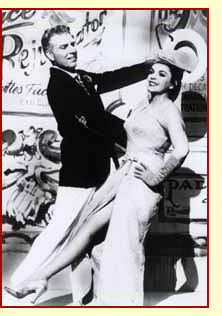 Evidently, the cut sect6ions
had been kept for several months and then destroyed, a common
practice at most major studios. I was convinced that if I could
get free, unlimited access to the studio vaults, a careful
combing through all those thousands of cans of film would turn
up the footage, possibly in mismarked cans. But studios don’t like novices, no matter how well
meaning, rummaging through their vaults, so it looked as though
I wouldn’t get the chance. Evidently, the cut sect6ions
had been kept for several months and then destroyed, a common
practice at most major studios. I was convinced that if I could
get free, unlimited access to the studio vaults, a careful
combing through all those thousands of cans of film would turn
up the footage, possibly in mismarked cans. But studios don’t like novices, no matter how well
meaning, rummaging through their vaults, so it looked as though
I wouldn’t get the chance.
One day, from out of nowhere, came a call from an apprentice
film editor at Warner Bros. Named Dave Strohmaier; he told me
that he had come across the complete mixed soundtrack to the
three-hour picture. He had not, however, been able to turn up
any footage. Then, one evening in November 1981, at the Academy
of Motion Picture Arts and Sciences, I hosted a tribute to lyricist
Ira Gershwin, which ended with an excerpt from A Star Is
Born: Judy Garland singing “The Man That Got Away.”
Introducing the finale, I commented on the fact that two of
Arlen and Gershwin’s best songs had been removed from
the film. Fay Kanin, president of the Academy and someone with
a long and close relationship with George Cukor, said afterward
how wonderful it would be if the complete version of the film
could be found.
In addition to being a writer of great sensitivity (Friendly
Fire, Hustling), Fay, who has a deep-seated and
passionate commitment to film, to film history, and to preservation,
is a member of the AFI Board of Trustees’ Preservation
Committee, chaired by Jeanine Basinger and including Brian O’Doherty
of the National Endowment for the Arts, Jean Firstenberg of
the AFI, Mary Lea Bandy of the Museum of Modern Art, and several
other individuals concerned with national archive issues. At
the request of the committee, the AFI’s board has designated
the next ten years the Decade of Preservation. A Star Is
Born seemed a perfect vehicle to highlingh the problems
of preservation. Questions had already been raised about the
stability of the film’s color negative; the mater stereo
sound tracks had evidently been erased years ago; and existing
prints were on the old Eastmancolor release stock, which has
a tendency to fade. So Fay contacted Robert Daly, chairman of
the board of Warner Bros., and he eventually granted permission
to go through the company’s film-storage facilities.

In
late spring 1982, I began my search on the East Coast at the old,
meticulously maintained Vitagraph storage facilities in Brooklyn,
owned by Warners since the late twenties. Nothing useful there,
though, and the same was true of the laboratories in midtown Manhattan
that had struck the prints. The next stop, back in Los Angeles,
was the Technicolor labs in Universal City, where I was aided
by Bob Schulte, who went through the history of A Star Is
Born’s print holding with me. Technicolor had made
the first set of prints for the full-length road-show version
in 1954; according to its September 1954 records, the company
struck 150 four-track stereo prints on Eastmancolor stock for
the first run. No more additional work was done until an order
came through to cut the master negative.
When A Star Is Born was cut, reels 3A and 3B were combined
to form a new, shorter reel known as 3AB. Cuts were also made
in 4A, 5A, 6B, 9A, and 9B. The excised negative material, the
“Trims and Deletions,” as the order phrased it, were
put in ten cans and shipped to the studio.
A later print order called for another 150 prints of the short
version made by the Technicolor dye-transfer process, to be used
during the second run. From the shortened master negative were
also made all the subsequent printing materials for 16mm and foreign
35mm use. So much for finding a full-length 16mm or overseas print.
The next step was trying to determine what happened to the 150
full-length four-track prints. According to the old studio files
now kept at the University of Southern California and the Warner
Bros. Distribution records at Princeton University, orders went
out in 1954 from the editorial department to all the film exchanges
across the country, telling them how to cut the prints and instructing
them to send the excised material back to the studio. We thought
perhaps some zealous editor-inspector might have kept the extra
footage.
During
the summer months, the Academy placed ads in trade publications,
but turned up nothing of interest.
Everything seemed to point to the studio.  If the material wasn’t
there, then it was pretty certain not to exist. Warners’
editorial and film library is under the calm but firm control
of Fred Talmage, vice-president in charge of postproduction, the
nerve center for everything that happens to a picture after it
comes off the sound stages. When I told him that I wanted to spend
my summer vacation prowling through the studio vaults, Fred just
smiled, shook his head, and said, “Well, Ron, Whatever
turns you on.” If the material wasn’t
there, then it was pretty certain not to exist. Warners’
editorial and film library is under the calm but firm control
of Fred Talmage, vice-president in charge of postproduction, the
nerve center for everything that happens to a picture after it
comes off the sound stages. When I told him that I wanted to spend
my summer vacation prowling through the studio vaults, Fred just
smiled, shook his head, and said, “Well, Ron, Whatever
turns you on.”
Our first stop was the Sound Department’s storage area under
what is known as the old Technicolor building to make certain
that Dave Strohmaier had been correct about the complete track
being there. It’s a huge subterranean basement, stretching
under the studio for nearly a quarter of an acre, lit by bare
bulbs, and in some areas thick with a fine dust that covers thousands
of cans of sound tracks and magnetic tape. Two Sound Department
veterans, Ed Chaplin and Phil Birch, took Fred and me through
the narrow aisles. We began pulling out cans marked “A STAR
IS BORN, Long Version YD-YF Mag Track,” which meant that
this was a monaural dialogue, music, and sound effects track on
magnetic film. There were twenty-three cans, and the only way
to find out if they were what we were looking for was to play
back one of the reels to see if it had the missing material on
it. Reel 3A was pulled; if all was well, it would have Esther
saying good-bye to the band – and by God it did! Things
were off to an auspicious start.
Finding the sound track was half the battle; now all we had to
do was locate the picture to match it. Fred turned me over to
Don Adler, who’d been working in the film vaults for almost
thirty years, cataloging every single piece of exposed film on
its journey from camera to release print. I asked him what would
have happened to the cans shipped back to the studio from Technicolor
containing the cut negative. “In those days,” he said,
“we’d keep it for six months, then junk it.”
Was it possible that some of it might not have been junked? “Possible,
but not likely.” According to Don’s inventory, there
were some miscellaneous cans of A Star Is Born material
in one of his storage areas. There were about twenty cans, none
of which had the appropriate Technicolor numbers on them.  Not
one of the reel numbers on the cans corresponded to the reels
that had been trimmed, but here was my chance to prove or disprove
my theory about the possibility of mismarked cans. Not
one of the reel numbers on the cans corresponded to the reels
that had been trimmed, but here was my chance to prove or disprove
my theory about the possibility of mismarked cans.
I
wound through the film, squinting at the 35mm images, looking
for something that was familiar to me from the stills of the
missing sequences. Can 7A had the first love scene between Norman
and Vicki, immediately after her preview triumph. It takes place
on the terrace of an exclusive Hollywood nightclub and is supposed
to dissolve into a scene in producer Oliver Nile’s office,
when they announce they’re going to be married. Instead,
I found I was staring at the missing scene on the recording stage
with Vicki singing “Here’s What I’m Here Fore,”
followed by the proposal and live microphone pickup.
I must have let out a loud yelp, because Don came running back
into the office to see if something had happened to me. I was
jumping up and down with excitement. If this one sequence was
there, could the others be far off? Don helped me carry in the
other cans of film, and I reeled through negative can after negative
can, hoping that lightning would strike twice. It didn’t,
but for the next two days I examined every single rack and every
single label on every single can of film in that basement storage
are.
“Where next?” I asked Don. “Try the stock-footage
library,” he replied. “I think they have a lot of
leftover material from the film.” Every studio has one of
these libraries;’ after a picture is put together, an editor
goes through all of the unused film and selects material that
might be useful in some future film. The Warners stock-footage
library is under the iron rule of Evelyn Lane, an imposing woman
who stands for no nonsense from anyone. Her long days are spent
in a cramped bungalow office stacked with miscellaneous cans
of film, overflowing file cabinets, rewinds, and editing tables.
“A
Star Is Born? Down there in the bottom drawer,” she
said, pointing while cradling a telephone on her shoulder and
typing up a requisition slip. She hung up and swung around t
explain that all fo the Warners features are listed by title,
with individual index cards for each piece of stock footage from
the movie.  She pulled out the bottom drawer and there, neatly
typed on five-by-seven-inch cards, were the descriptions of all
the unused negative segments from A Star Is Born, with
a sample frame of each negative on each card. They were all broken
down into subject categories - “Apartment Houses,” “Automobile Traffic,”
Drive-in,” “Life Rafts,” “Los Angeles
Exteriors’ – with a one-line description of what was
one each piece of film. I pulled out the card marked “Bus”
and read, “Day. But with lettering GLENN WILLIAMS ORCHESTRA
on side pulls away from Motel.” I began to get excited again.
This was Esther’s good-bye to the band. She pulled out the bottom drawer and there, neatly
typed on five-by-seven-inch cards, were the descriptions of all
the unused negative segments from A Star Is Born, with
a sample frame of each negative on each card. They were all broken
down into subject categories - “Apartment Houses,” “Automobile Traffic,”
Drive-in,” “Life Rafts,” “Los Angeles
Exteriors’ – with a one-line description of what was
one each piece of film. I pulled out the card marked “Bus”
and read, “Day. But with lettering GLENN WILLIAMS ORCHESTRA
on side pulls away from Motel.” I began to get excited again.
This was Esther’s good-bye to the band.
There were nearly two hundred entries for A Star Is Born,
and some of this negative material had been printed up for possible
use. Evelyn took me to the vault holding the printed material,
and I began going through dozens of cans, finding numerous takes
of the film’s scenes, mostly long and medium shots, carefully
edited to that the principals are not visible.
Hoping there might be more than this among the negative material,
I asked Evelyn to take me to that storage vault, made up of long,
narrow concrete bunkers filled with rank upon rank of film cans
– 150 of them from A Star Is Born. Each can had
several tightly wound rolls of negative material with a paper
label describing the contents. The label on can number 90 read:
“Judy Garland sings ‘Lose That Long Face.’”
The anonymous stock-footage editor had saved every alternate
take of the musical numbers in the film, including the puppet
commercial. There seemed a good chance that all the missing dramatic
footage, in alternate takes, might be here too.
For the next three weeks I went through the 150 cans, examining
every roll, but the all-important close-ups and medium shots of
the leads playing the deleted scenes were nowhere to be found.
My last hope was the storage vaults for the library prints, the
copies that are kept for use by the studio. I worked my way through
all these vaults, finding nothing, until finally only one more
remained.
Vault 120 looked no different from all the others before it, except
that in the back were some tall cardboard boxes of the type that
film cans are shipped in. Near the airduct grating in the very
rear were two boxes, about three feet high, sealed with no labels
other than the Technicolor emblem. I opened the first one and
looked at the cans: The Bounty Hunter, a Randolph Scott
Western from 1954. The other box was sealed tightly with masking
tape. From the look of it, it had never been opened, but I finally
managed to peel off the tape and break open the sealed top. There
was a silver can inside with the distinctive blue Technicolor
label, and on the label were the words “A STAR IS BORN R12A.”
a yellow shipping receipt had the date, October 4, 1954.
I opened the top can, and inside were the black waxed bags that
film is shipped in; they had never been opened. I began pulling
out those cans furiously, looking for two separate reels, 3A
and 3B, which would tell me that this was a complete, uncut print. 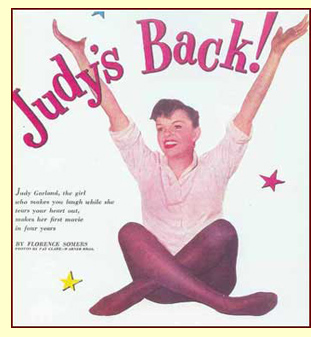 By the time I got down to the bottom of the box, I was shaking
so much that I dropped my flashlight and had a hard time reading
the numbers on the top; there was 4B, then 4A, and finally “Reel
3AB.” By the time I got down to the bottom of the box, I was shaking
so much that I dropped my flashlight and had a hard time reading
the numbers on the top; there was 4B, then 4A, and finally “Reel
3AB.”
It was the cut version. I sat there for a couple of minutes,
completely dejected; there was nothing to do but admit that everyone
had been correct – the missing sequences were irretrievably
lost. However, about 20 minutes of usable deleted footage, a
complete, 181-minute monaural soundtrack, 154 minutes of stereo
sound track (which was on the studio print), and the mint-condition
Technicolor short version had been found.
I
occurred to me that we could take the bits and pieces of film
that we ’d found in the stock-footage vaults, and, using
the sound track and the editor’s script as a guide, put
the shots back where they belonged. The several minutes where
we had no visuals could be filled in using stills of the missing
scenes. Stills have been used successfully before, notably in
Butch Cassidy and the Sundance Kid and Raging Bull, but never
before in a restored film. Robert Swarthe, special effects genius
and animator par excellence, told me it could be done, but it
would be expensive – maybe $25,000. Lisze Bechtold Blyth,
a prizewinning animator, agreed to take on the project, if we
could get approval and money.
Once Fay Kanin got the approval of George Cukor and Gene Allen,
production designer on A Star Is Born, she went back
to Robert Daly and asked for Warners’ financial support
in reconstructing the film and help in setting up a series of
fund-raising screenings for the Academy’s ongoing archival
work. Daly was interested, but cautious. He proposed that we do
a test reel, and authorized $5,000; we said we’d come back
in tow months. The day after the meeting, Lisze, Gene, the Academy’s
Douglas Edwards, a young editor named Craig Holt, and I began
meeting in the Academy’s editing room. We decided to start
right at the beginning of the deletions, with Esther’s farewell
to the band, and then go through Norman’s being drive off
to location. Esther’s waiting for his call, and all of the
other missing bits right up to Esther’s doing the voice-over
for the puppet commercial. Evelyn Lane pulled the negative segments
we needed.
We were nervous about the color quality, but the material, when
it came back from the laboratory, looked absolutely beautiful.
Craig and I began the arduous task of looking at the various takes
and trying to match them with what was happening on the sound
track. It was much like putting together a jigsaw puzzle. We cut
in blank film w3here we had no picture; then Lisze, Gene, and
I timed this blank footage, and worked out the camera moves across
the stills.
All this took almost five weeks to work out, and on the day that
Lisze brought in the results of her first shooting, we were all
a bit nervous. The lights went down, the picture faded in, and
the camera traveled across a still of the Glenn Williams Band
bus, coming to rest on Judy Garland as, on the track, voices of
the men in the band said their farewells. It looked wonderful,
and the sound and the image matched up beautifully.
So Fay set up a screening for Daly; George Cukor was going to
attend, too. But the night before the screening, the telephone
rang and I was told that George had died. I was stunned.
 It
was a very depressed group that met at the Academy’s Samuel
Goldwyn Theater on the evening of January 25, 1983. However,
Fay reminded us that we had a great opportunity here. In reconstituting
the film and presenting it to audiences, we would not only be
restoring a marvelous movie but celebrating George. Suddenly
there was a renewed spirit of commitment, shared by Daly when
he arrived. The picture looked and sounded spectacular, and three
days later Fay excitedly called to say that he had agreed to
back the project. It
was a very depressed group that met at the Academy’s Samuel
Goldwyn Theater on the evening of January 25, 1983. However,
Fay reminded us that we had a great opportunity here. In reconstituting
the film and presenting it to audiences, we would not only be
restoring a marvelous movie but celebrating George. Suddenly
there was a renewed spirit of commitment, shared by Daly when
he arrived. The picture looked and sounded spectacular, and three
days later Fay excitedly called to say that he had agreed to
back the project.
Then came another lucky break. At the Academy’s urging,
Jim Parker of Eastman Kodak agreed to donate the raw stock that
we needed to complete the project. The longevity of the color
negative had been verified by the beautiful prints we were getting
from the stock footage. We wanted to print our restored sequences
on the new Eastman Kodak print film 5384, with its vastly improved
dye stability. This gift freed a large chunk of our budge, which
could then be used to restore the stereo sound track.
Craig, Lisze, and Gene worked days, nights, and weekends, joined
by D.J. Zeigler of the Academy’s Film Department and Fred
Talmage and his technical staff at the studio, to finish in time
for the public showings. A Premiere was set for July 7 at the
Radio City Music Hall, with screenings to follow in Chicago,
San Francisco, Los Angeles, and Dallas.
These presentations will serve to advance the cause of film preservation
and to remind audiences of the achievements of George Cukor, Judy
Garland, James Mason, Moss Hart, Harold Arlen and Ira Gershwin,
musical director Ray Heindorf, cinematographer Sam Levitt, and
the dozens of other Hollywood crafts people whose work made A
Star Is Born the overwhelming theatrical experience that
it will once again prove to be. Finally, the presentations will
serve to give audiences the chance to experience hundreds of “those
little jabs of pleasure.”
Ronald Haver
American Film Magazine
Volume VIII Number 9
July-August 1983
top of page |


